Saturday, December 3, 2016

Aakashdeep

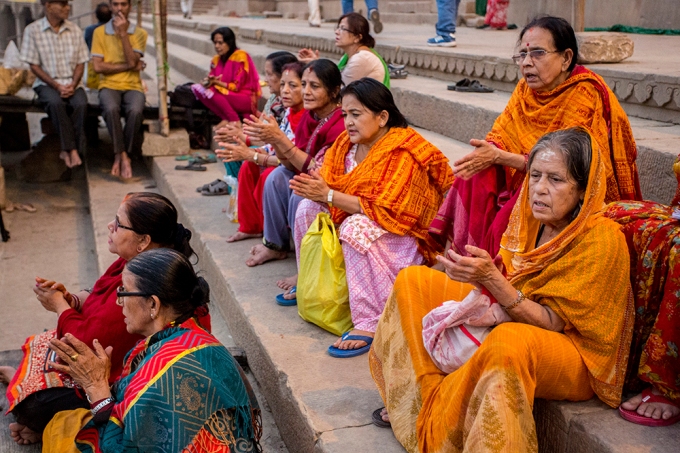
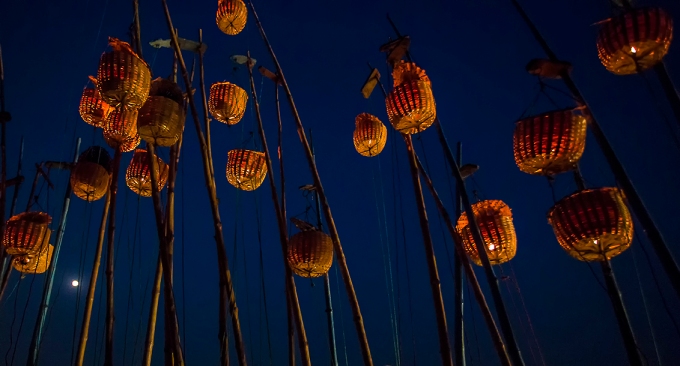
Long, lean bamboo poles with bamboo baskets dangling on the upper tips stood in clusters on Madhis (the platforms on both sides of the steps leading to Ganges.) on various ghats of Ganges at Varanasi. This is a common site on ghats in the Hindu month of Kartik. Every evening Diyas [earthen lamps] are lighted and placed in these baskets in the memories of ancestors, the symbolic significance being that these lamps light the path of the departed soul upto heaven. These are known as Aakash deep or Aakash kandeel. The tradition is said to run from as long as people can remember.
As twilight descends, the ripples on Ganges water hitherto bathed in golden sunlight, dancing merrily get sombre.Sky overhead dons it's inky blue night gown and Ganges flows placidly absorbing the calm greys of atmosphere. Groups of men and women with their pooja baskets start gathering near these bamboo poles.
This was the Kartik month of 2016 and we were on Nepali ghat at that evening. Preparations for lighting diyas were on. The hanging  baskets were lowered with the help of thin ropes attached to pulleys and baskets. Diyas taken out, filled with oil and fresh cotton wicks,  the lighted diyas placed inside basket and the basket once again pulled up on the poles.  The dangling baskets facing the sky and the flickering lights of Diyas paying homage to departed souls, women making rangolis near poles, chanting shlokas, praying with folded hands, lighting few more diyas on ground near each pole in the name of Gods and Goddess.... the entire scene filled the heart with peace and content. It was like a bridge of bonds and emotions has been erected from earth to heaven.The lighted baskets overhead moved slowly, rhythmically on the tune of winds. It felt as if the souls of ancestors are expressing their happiness, bestowing their blessings. What a beautiful concept of remembrance, gratitude and duty.
It is said that corresponding to the Diya in Aakash deep one more Diya is lighted on the ground near the respective pole. As if denoting that the lineage is alive and continuing. This one Diya is essentially lighted while rest are optional. one can light as many as one wants in the names of kul devtas, devis and other Gods.
 On one of the ghats these Aakash deeps were lighted in memory of martyrs, who lost their lives defending our country  during various terrorists attacks.
We also witnessed lighting of Aakash deeps at Ganga Mahal Ghat on the terrace of Krishna temple. on ghats the poles were erected on Madhis (рдордв़ी) near the steps of Ghats and the reflection of lighted Diyas could be seen in the Ganges water. View of Aakash deeps on terrace of temple from the ghats looked like a group of fireflies.
Aakashdeep are like lighted verse of prayers reaching zenith.
This month long event culminates on the day of Kartik Poornima.,when the glorious moon steps out in it's most magnificent form, smiling and assuring the lamps that the journey of light will go on for ever. 
deep_39nw

deep_59w

deep_60wdeep_57w

All pictures by Sunder Iyer.

Saturday, November 19, 2016

Bhishm Panchak


Recently when we visited Varanasi on the occasion of Dev Deepawali we found these idols on the steps of many Ghats. The one on Kedar Ghat was sculpted in a bit elaborate way while others like that on Gai Ghat were simple but each of them was being worshiped . These idols represent Bhishm Pitamah lying on bed of arrows on the battle ground of Kurushetra. The idols are sculpted on the day Ekadasi of Kartik Mas and immersed in the Ganges after Kartik Poornima. This period is known as Bhishm Panchak. Pitamah Bhishm fasted for these last five days of his life getting ready to give up his life. As our mythological texts tell us that Bhishm Pitamah had a boon to give up his life whenever he wanted. Nobody could have killed him.
People observe fast these last five days of Kartik mas and worship Bhishma. Those who observe vrat for entire Kartik Mas intensify it for these last five days.
Entire Kartik Mas is considered to be very sacred in Hindu religion. Ghats of Ganges at Varanasi witness many religious activities, specially held during this period. Bhishm Pitamah was Ganga Putra hence perhaps his last days on earth are remembered in this unique way here. Tarpan in Ganges, immersion of ashes of departed in Ganges is considered very significant and sacred in Hindu religion. Ganga Putra Bhishm's worship and his departure from earth to affectionate lap of his mother is observed with all the devotion, rites and rituals.
The various colored silken threads of  deep emotions, devotion weaving the charismatic tapestry of our cultural heritage always fills my heart with amazement and calm.

Pictures --- Sunder Iyer.


Thursday, November 17, 2016

Seeking answers


I sat on the steps of a ghat at Varanasi looking around, seeping in the essence of ongoing activities on the banks of holy Ganges. I always enjoy watching people guessing about their lives, thoughts etc. The experience is like weaving stories where outline has been provided or say filling colors in a sketch. Ghats of Varanasi are perfectly ideal place for this.Varied people, varied activities.... each one busy in one's own world. My roaming glances suddenly fell upon this old gentleman. He sat all alone on a bench, clad in fairly neat clean clothes. But what caught my attention was that he was trying to beg from the people passing near the bench. The way he was hesitantly extending his palm and mumbled clearly showed that he was not accustomed of begging. Moreover he sat on bench like any other pilgrim and his attire too was in pretty good condition. But above all the expression of his deep sad eyes. Every time he extended his palm as if something died inside him. I watched him for quite some time. In the mean time few people had dropped one or two coins on his palm. I went to him and talked.
He told me that his name was Subramaniam. He belonged to Hyderabad. He had a grocery shop there.Three months ago his sons brought him to Varanasi and left him there. He was not well at that time.
I asked him whether he was collecting money to return to his home as he appeared to be fairly capable of traveling now.
The sadness in his eyes deepened a bit but a quiet detachment lingered on his face. '' return ! to whom ? They left me here. Soil of this place is miraculous. It revived me. Now I owe my existence to it. This is my Karma.'' Somehow there was neither anger nor grudge but a calm acceptance.
In the night he sleeps in a medicine shop and days he mostly spends on ghats.
I would have loved to know more about him, the thoughts churning in his mind, the emotions swirling in his heart but connecting bridges are not built in a day, so I bid adieu leaving him to search his own answers.


Pictures courtesy --- Sunder Iyer.

Sunday, September 11, 2016

Nandi at Lepakshi

n Hindu Mythology Shivalinga and Nandi are inseparable. Wherever there is a temple dedicated to Lord Shiva, an idol of Nandi is sure to be found  inside the temple complex.Nandi at Lepakshi is a bit different in the way that it is outside the temple enclosure, say about five hundred meter away on the road side. But then so is the big majestic Shivalinga in the temple. Infact the main deity of this temple is Veerbhadreshwara, a form of Lord Shiva only and the very artistically carved Nagalinga is  in the open courtyard of the temple outside the sanctum. The Nandi faces this Shivalinga.May be during the time both these were sculpted there were no high buildings in that five hundred meter stretch and Nandi even from that distance was able to continuously gaze his beloved lord and master.
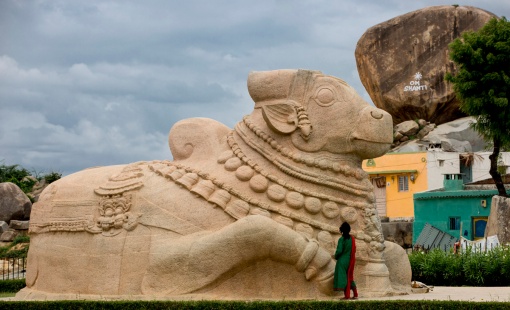
This splendid Nandi bull is of gigantic dimension, approximately 4.5 meter high and about 8 meter long.This monolithic bull is a spectacular example of prodigiously talented artists of the Vijayanagar empire period.The massive Nandi bull like a guard presides over the entrance of Lepakshi town.
The exquisitely carved details of ropes, belts and bells over the body of Nandi are one of the finest example of stone craftsmanship.


lepa-2


For ages it sits elegantly under the open sky rapt in the bhakti of the supreme Lord.


lepa_4


Look at those intrinsically carved details of all the ornaments…and the expression of Nandi Maharaj…I can almost see a delicate smile lingering on His face. Are you able to make out the mythical bird with an elephant in it’s claw, hanging as a locket from the chain? Well, it is said to be an insignia of Vijayanagar kings.


lepa_1


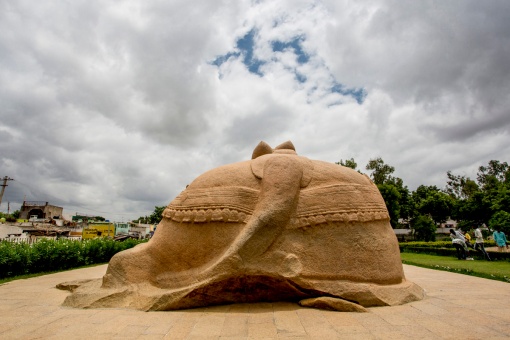
Like me do you too find a Ganesha reflected here?


lepa_2


The green lawns. shady trees and rocks here and there… a perfect setting to set you on pondering mode about our rich cultural heritage…the bygone times….almost tempting you to jump into a time machine and live that era for some time.


bedni1_2nnnnn


The lotus ponds and the rocky terrain stretched around makes it a perfect spot to spend leisurely time.
Nearby this spot is Andhra Government guest house with fooding and lodging facilities.


All the pictures by Sunder Iyer.


Saturday, September 10, 2016

Murals at Lepakshi

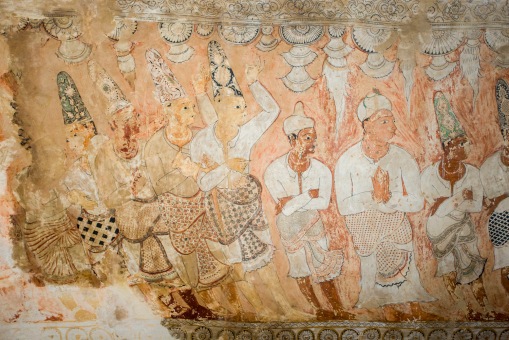
Sri Dakhinmurthy is the form of Shiva that depicts Him as cosmic guru, imparting wisdom which enlightens and enriches. The iconographic depiction of the form though not consistent mostly illustrates Shiva in a seating posture, under a Vat Vriksha, His right leg stretching down resting on a dwarfish demon.This demon symbolically represents lack of knowledge. In the fresco at Lepakshi though Shiva’s foot does not rest on demon but he can be seen near His foot. As Dakhinmurthy extolls Shiva in supreme teacher form, His one hand is shown in gyan mudra. Normally Rishis, munis are seen sitting on the ground near Him imbibing the divine words.But in this mural at Lepakshi the artists have mingled the prevelent local cultural influences. On Shiva’s head rests a cap like Sufi saints. Jana receiving/ arriving to receive the Gyan are seen dressed like Sultans and Muslim saints. Creatures from Hindu mythology too can be seen and near the demon is perhaps standing goddess Parvati. The creative liberty mixed in right dozes with mythological references makes this mural an interesting document of history, culture, spiritual beliefs and interpretation.

lep_14w

Kiratharjuniyam is a sanskrit Mahakavya composed by Bhairavi narrating the story of severe penance by Arjun to obtain weapon Pashupatha from Lord Shiva in order to defeat Kaurava in the battle and the in between incidents till he finally becomes successful in his mission.
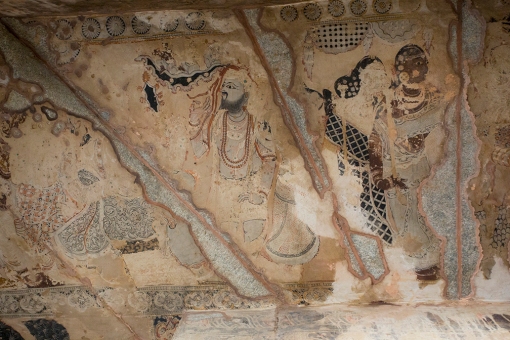
Fresco below depicts one of the scenes from Kiratharjuniyam.Perhaps a scene from the very beginning of the story where Vyas muni advises Arjuna to obtain weapon Pashupatha. Though fresco has suffered a lot through ages yet muni can be seen clearly.The lady in black can be Draupadi and the figure next to her one of the Pandavas.Or may be it depicts Arjuna asking permission of Yudhisthara to leave to forest for doing penance.Whatever it might be despite the damage due to vagaries of time the intricacies of human features, ornaments etc is very endearing.

.lep_20w

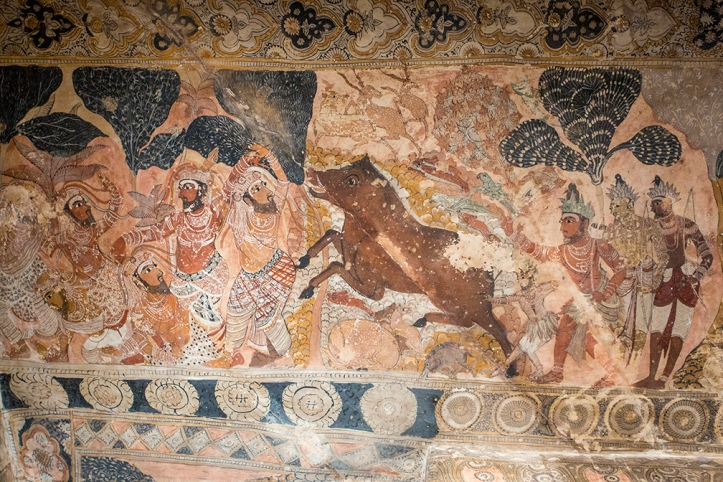
This one is the boar hunt scene from Kiratharjuniyam — Arjun tried to attack boar from one side while Lord Shiva, disguised as  Kirath attacked from other side. During hunt Arjun realized that it is not any ordinary Kirath and Shiva appeared before him in His real form and later on granted the boon of weapon Pashupatha.

lepa-w

Below are the scenes of Draupadi’s svayamvara. On leftmost side is shown Kala-Bhairava  with eight arms holding a severed human head and a bowl and His vahana dog is depicted nearby. Two persons, one short and another tall are shown in front of him, one of them would be Drupad worshiping his tutelary God. Next on right is King Drupad , Draupadi, his daughter is shown seated on his lap.This made me remember a ritual of marriages in South India being carried out till date, where the bride sits on the lap of father while the bride groom ties the Thali [ Mangalsutra} and Kanyadan is performed. How deeply rooted and connected are our rituals, customs etc. Next on right, in front of Drupad, Arjuna is shown shooting the matsya-yantra (fish dial) with an arrow looking its reflection in the water below the dial. This follows by the marriage of Arjuna with Draupadi.
.
lepakshee (6)_1 Draupadi swayamvara
lepakshee (1)_1
Draupadi Swayamvara.
Here are shown Virupanna and Viranna  worshiping their tutelary deity, Veerbhadra, with their family members.As per a legend, the Veerbhadra temple was constructed by Virupanna using the state treasury. The king came to know about it and announced the punishment that Virupanna  be blinded. When Virupanna heard this order, he executed it on his own on the same spot. Local guides will show you the place inside the temple where they say Virupanna threw his eyes.
lepakshee (2)_1
Virupannas retinue
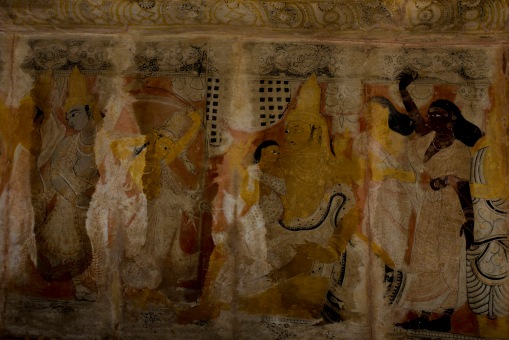
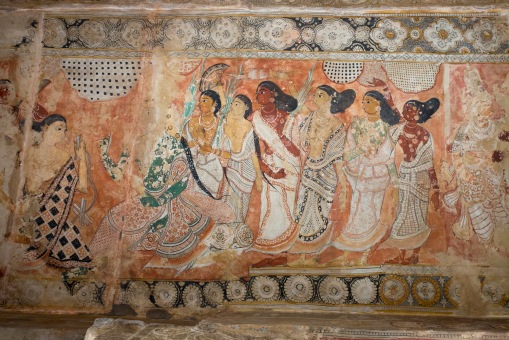
Here is Goddess Parvati with her friends and attendants. May be a scene before marriage of Shiva – Parvati. It is a lively piece of painting. The attires, the hair styles…variety is astonishing and reflects the skill of artist to capture trends of the time beautifully.
lepakshee (3)_1
Parvati with friends and attendants.
This one next to the above one depicts the most favourite theme of the artists of yester years India….Shiva – Parvati marriage
lepakshee (5)_1
There are many others mythological anecdotes painted there —a mural depicting King Muchukunda, the monkey-faced legendary Chola king who is attributed to have established Lord Thyagaraja at the Tiruvarur temple from the heavens,   Shiva and Parvati playing Chess, coronation of Rama,Nataraja dancing while other demi- Gods played various musical instruments and a large panel depicting the story of the legendary just king Manunidhi Cholan etc.
Veerbhadreshwara temple at Lepakshi is one of the greatest treasure of murals and frescos .These jewels of art not only depict the mythological themes but also documents the prevalent trends of social life of that time.
All the pictures by Sunder Iyer.


Tuesday, August 9, 2016

Temple at Lepakshi --part 1

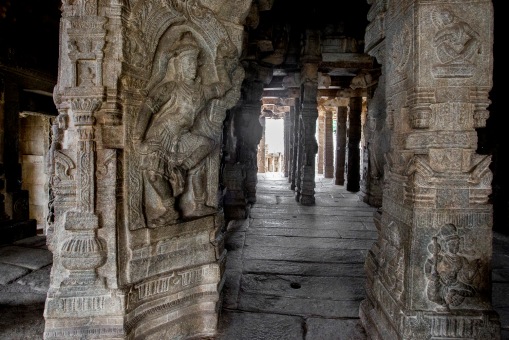
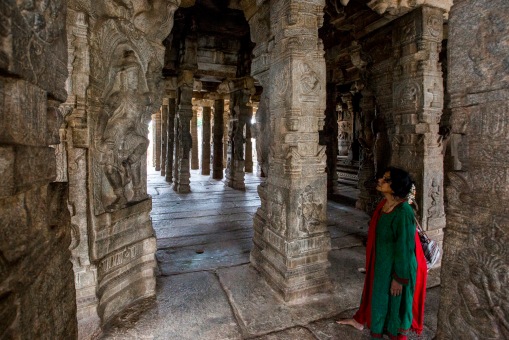
We started from Bangalore at about 6 A.M and reached Lepakshi by 8 O’clock.Lepakshi is a small non-decrepit town in Anantpur district of Andhra Pradesh Veerbhadreshwara temple at Lepakshi  is one of the finest example of  artistry of craftsmen of that era.Grand, massive sculptures, delicate, intricate carvings on stone, ceiling adorned with murals depicting mythological tales…this temple has a lot to offer to leave us spellbound.
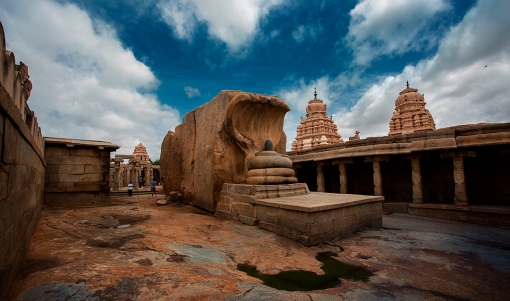
Standing below the high raised platform on which the huge splendid Shivlinga is carved, is a humbling experience.Three coils of Naga around Shivlinga led to its seven hooded magnificently carved head stretching over Shivalinga.Craning my neck as I tried to look at the topmost point of the entire sculpture, i had a sudden feeling as if the  canopy of those seven hoods is descending directly from the bright blue morning sky overhead. The Linga transformed into that mythical  pillar of light connecting the earth and the heaven, the  manifestation of limitless Shiva energy. Perhaps it is not just the grace, the magnificence of masterpiece carved by the great artists of yesteryear but all their commitment and devotion which to this day start resonating in our hearts once we stand there silently with our   heads bowed, imbibing the  sacred spirit.The open courtyard bathed in soft morning glow gave the entire scene a haloed touch. Shadows in the covered verandah walking along the courtyard appeared to be harboring many untold stories. Such are the moments when you feel at peace with yourself.

bedni1_3niksharpncropfinalwww


Chiselled on the other side of the huge rock behind the Nagalinga is  Ganesha, calm, quiet and peaceful.I love Ganesha idol in this form – the big belly resting on the ground, the legs denoting the sitting posture and his small vahan mouse in front.  Various symbolical interpretations are available for His body parts and His Vahana but to me He radiates substance, faith, confidence and dignity, He always fills me with a kind of intrinsic joy, a kind of happiness you feel on being comfortable with your own being. And the tiny Vahana– more than anything else it’s our faith that make us traverse through the life.

lep_10nww

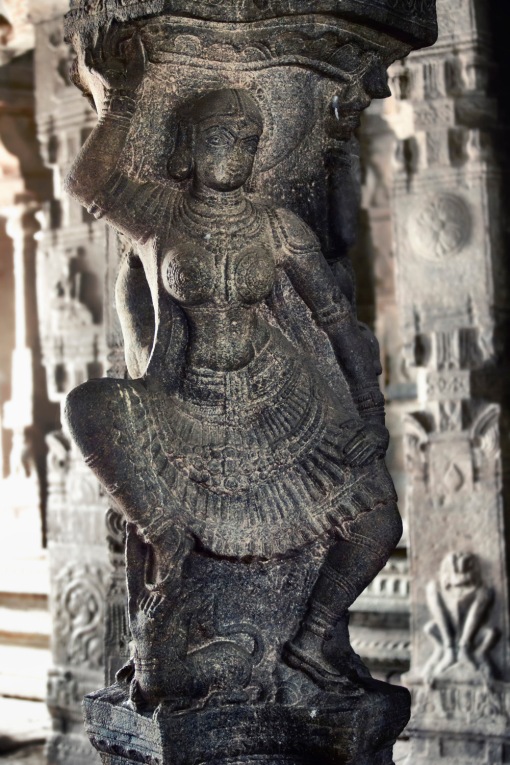
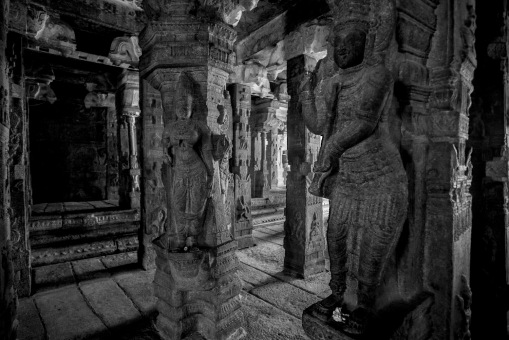
The Natya Mandapam of Veerbhadreshwara temple at Lepakshi is a sculpted ode to the artistry of carvers and chisellers of sixteenth century Southern India.Impressive sculptures of divine dancers, drummers and other musical instrument players in half-reliefs on the granite pillars are so intense and alive that you almost feel them in actions. The rhythm in shapes, palpable emotions, glorious manifestations impart the stones a dream like feel. Early morning sunlight tip toes the mandapam from one side and the shadows in the pavilion simmer, the dark corners get suffused with golden dust and the bygone era as if awakens…..

lep_3nnnnn

lep_6

lep_4

lep_2nnnww_scaled

lep (2)

lep_5

lep_7n

lep_8

lep_12

This Natya Mandapam has about seventy pillars and one of these is an architecture wonder beyond comprehension.The hanging pillar– this pillar like all other pillars is attached to the ceiling but does not touch the floor below. Such heavy granite pillar…how can it hang ! Presently it stands a bit dislodged from it’s original position. It is said that during British times certain enthusiastic engineers tried to fathom the secret behind this marvel and in turn, the pillar suffered. However faith of people put it on divine pedestal. It is believed if you pass any cloth underneath it,the wish you sought will be fulfilled.

lep_13

All pictures by Sunder Iyer

Thursday, July 21, 2016

An evening in pine jungles

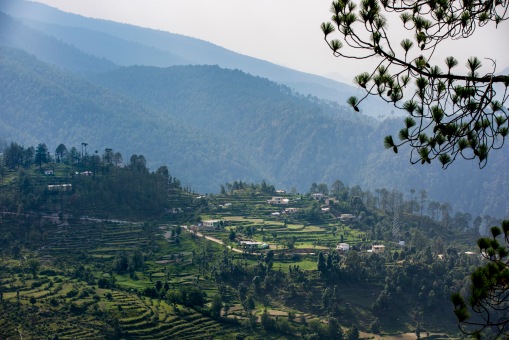
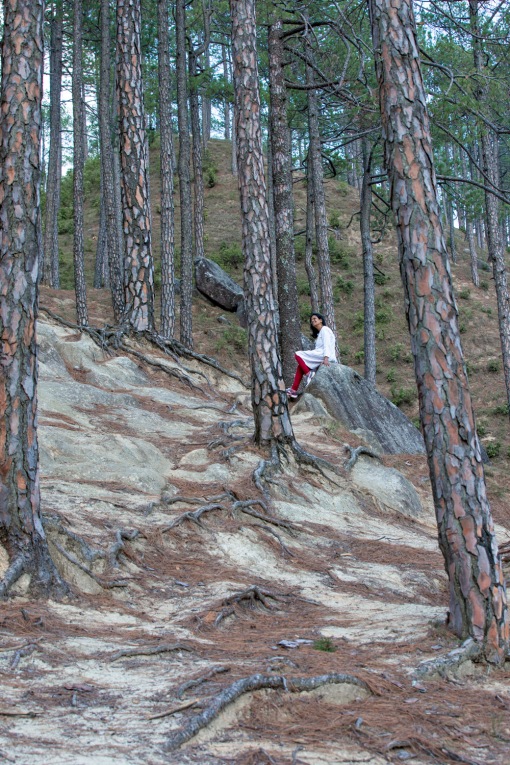
From the first floor verandah of Kumainu-Garhwal mandal tourist guest house at Gwaldam, hills beyond the market square buildings were  clearly visible and slowly climbing file of stately pine trees was inviting.  Slightly left to the hills, tiers of mountain and peaks were cloaked in thick grayish white clouds.We were told that on a clear sparkling day the snow capped Himalayan peaks under the blue canopy of sky offer a magnificently divine view from that point but that day we were soaking in the surreal mystique feel.While talking to the locals we gathered that at the farthest tip of pine adorned hills there is a small ,beautiful grass land.We suddenly planned to visit that. We finally could not make upto that point as we had started quite late and it  being a cloudy day the darkness descended earlier than usual. However we enjoyed our  leisurely ascent midst pine jungle.
The cab could take us upto the school building and from there onwards we  climbed in the august company of lofty pines. .A kind of bitter sweet fragrance of slightly moist pine woods , ground carpeted with golden yellow needles of pine,stately pines adhering to earth with all their might yet appearing aloof to things around bearing a saint like equanimity….the conglomerated impact of all these elements of nature somehow takes you to an entirely different planes.The chains and burdens on your being start dropping one by one and sitting there with your back resting against one of the pines if your eyes stroll to the upper most tips of pines, you feel nearer to heaven than earth.
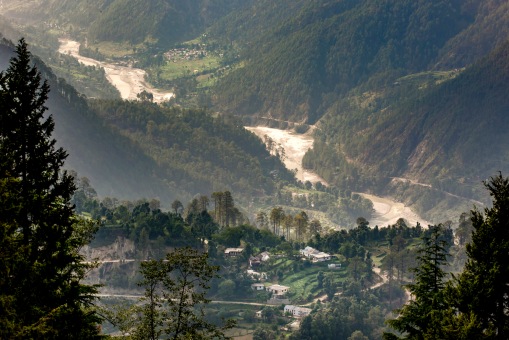
This ridge provides a beautiful view of valley on another side. Kosi river snakes through the valley. it’s silvery band shimmered  midst the green, blue haze.
Pine needles dropped silently while tall, magnificent trees stood  like powerful warriors with golden heart. Their sermons can be clearly heard by a keen ear and dedicated heart.I gathered some pine cones fallen on ground. Some were ripe and dried, some were small green and sticky.perhaps the untimely separation from parent branch caused the raw wound and heart bled .
We roamed around enjoying the picturesque landscape, the sylvan scenes, inhaling delicious fragrance of woods.The evening proved to be a perfect prelude to our Bedini trek.

bedni_26n

bedni1

bedni1_1

bedni1_2

bedni1_3

bedni1_4

bedni1_5

bedni1_6

bedni1_8
All pictures by Sunder Iyer