Showing posts with label architecture. Show all posts

Sunday, September 11, 2016

Nandi at Lepakshi

n Hindu Mythology Shivalinga and Nandi are inseparable. Wherever there is a temple dedicated to Lord Shiva, an idol of Nandi is sure to be found  inside the temple complex.Nandi at Lepakshi is a bit different in the way that it is outside the temple enclosure, say about five hundred meter away on the road side. But then so is the big majestic Shivalinga in the temple. Infact the main deity of this temple is Veerbhadreshwara, a form of Lord Shiva only and the very artistically carved Nagalinga is  in the open courtyard of the temple outside the sanctum. The Nandi faces this Shivalinga.May be during the time both these were sculpted there were no high buildings in that five hundred meter stretch and Nandi even from that distance was able to continuously gaze his beloved lord and master.
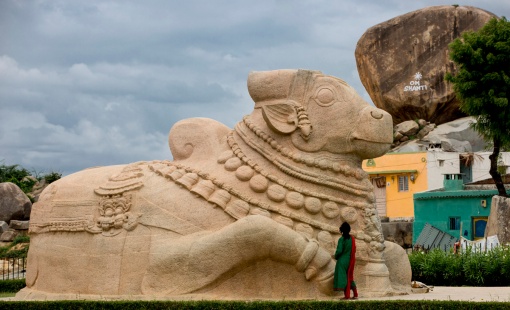
This splendid Nandi bull is of gigantic dimension, approximately 4.5 meter high and about 8 meter long.This monolithic bull is a spectacular example of prodigiously talented artists of the Vijayanagar empire period.The massive Nandi bull like a guard presides over the entrance of Lepakshi town.
The exquisitely carved details of ropes, belts and bells over the body of Nandi are one of the finest example of stone craftsmanship.


lepa-2


For ages it sits elegantly under the open sky rapt in the bhakti of the supreme Lord.


lepa_4


Look at those intrinsically carved details of all the ornaments…and the expression of Nandi Maharaj…I can almost see a delicate smile lingering on His face. Are you able to make out the mythical bird with an elephant in it’s claw, hanging as a locket from the chain? Well, it is said to be an insignia of Vijayanagar kings.


lepa_1


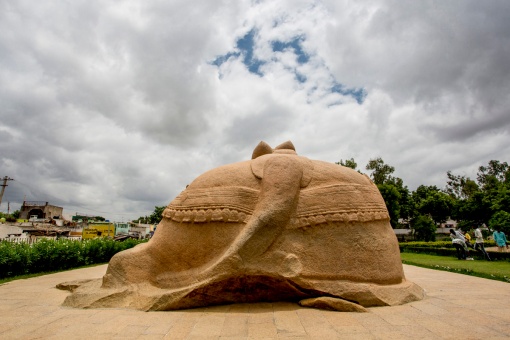
Like me do you too find a Ganesha reflected here?


lepa_2


The green lawns. shady trees and rocks here and there… a perfect setting to set you on pondering mode about our rich cultural heritage…the bygone times….almost tempting you to jump into a time machine and live that era for some time.


bedni1_2nnnnn


The lotus ponds and the rocky terrain stretched around makes it a perfect spot to spend leisurely time.
Nearby this spot is Andhra Government guest house with fooding and lodging facilities.


All the pictures by Sunder Iyer.


Tuesday, August 9, 2016

Temple at Lepakshi --part 1

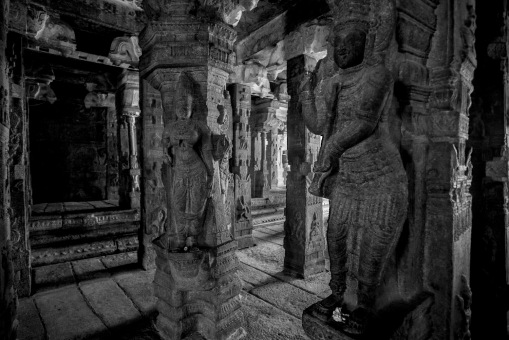
We started from Bangalore at about 6 A.M and reached Lepakshi by 8 O’clock.Lepakshi is a small non-decrepit town in Anantpur district of Andhra Pradesh Veerbhadreshwara temple at Lepakshi  is one of the finest example of  artistry of craftsmen of that era.Grand, massive sculptures, delicate, intricate carvings on stone, ceiling adorned with murals depicting mythological tales…this temple has a lot to offer to leave us spellbound.
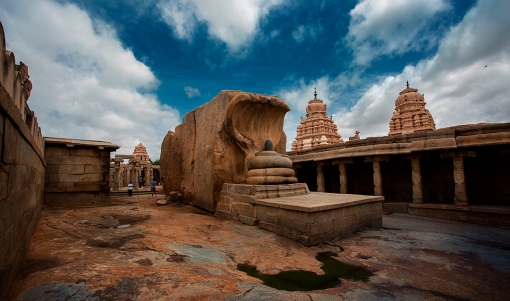
Standing below the high raised platform on which the huge splendid Shivlinga is carved, is a humbling experience.Three coils of Naga around Shivlinga led to its seven hooded magnificently carved head stretching over Shivalinga.Craning my neck as I tried to look at the topmost point of the entire sculpture, i had a sudden feeling as if the  canopy of those seven hoods is descending directly from the bright blue morning sky overhead. The Linga transformed into that mythical  pillar of light connecting the earth and the heaven, the  manifestation of limitless Shiva energy. Perhaps it is not just the grace, the magnificence of masterpiece carved by the great artists of yesteryear but all their commitment and devotion which to this day start resonating in our hearts once we stand there silently with our   heads bowed, imbibing the  sacred spirit.The open courtyard bathed in soft morning glow gave the entire scene a haloed touch. Shadows in the covered verandah walking along the courtyard appeared to be harboring many untold stories. Such are the moments when you feel at peace with yourself.

bedni1_3niksharpncropfinalwww


Chiselled on the other side of the huge rock behind the Nagalinga is  Ganesha, calm, quiet and peaceful.I love Ganesha idol in this form – the big belly resting on the ground, the legs denoting the sitting posture and his small vahan mouse in front.  Various symbolical interpretations are available for His body parts and His Vahana but to me He radiates substance, faith, confidence and dignity, He always fills me with a kind of intrinsic joy, a kind of happiness you feel on being comfortable with your own being. And the tiny Vahana– more than anything else it’s our faith that make us traverse through the life.

lep_10nww

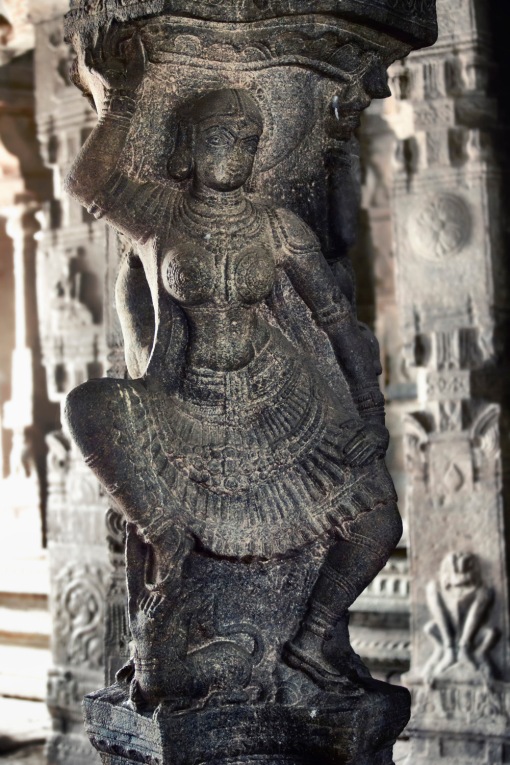
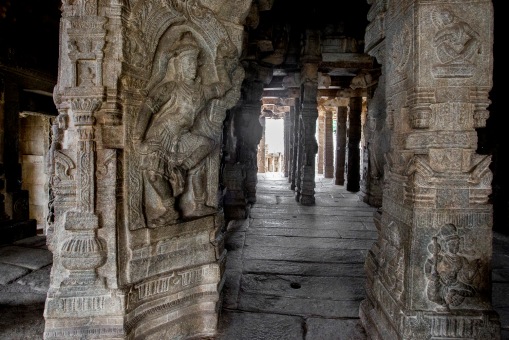
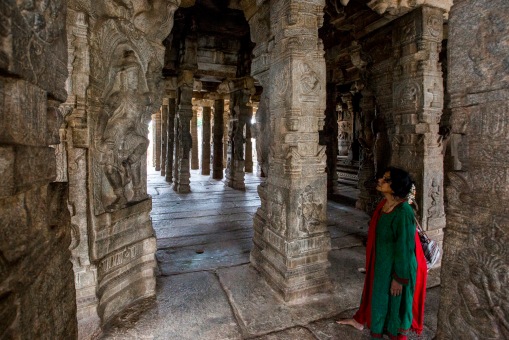
The Natya Mandapam of Veerbhadreshwara temple at Lepakshi is a sculpted ode to the artistry of carvers and chisellers of sixteenth century Southern India.Impressive sculptures of divine dancers, drummers and other musical instrument players in half-reliefs on the granite pillars are so intense and alive that you almost feel them in actions. The rhythm in shapes, palpable emotions, glorious manifestations impart the stones a dream like feel. Early morning sunlight tip toes the mandapam from one side and the shadows in the pavilion simmer, the dark corners get suffused with golden dust and the bygone era as if awakens…..

lep_3nnnnn

lep_6

lep_4

lep_2nnnww_scaled

lep (2)

lep_5

lep_7n

lep_8

lep_12

This Natya Mandapam has about seventy pillars and one of these is an architecture wonder beyond comprehension.The hanging pillar– this pillar like all other pillars is attached to the ceiling but does not touch the floor below. Such heavy granite pillar…how can it hang ! Presently it stands a bit dislodged from it’s original position. It is said that during British times certain enthusiastic engineers tried to fathom the secret behind this marvel and in turn, the pillar suffered. However faith of people put it on divine pedestal. It is believed if you pass any cloth underneath it,the wish you sought will be fulfilled.

lep_13

All pictures by Sunder Iyer

Wednesday, November 5, 2014

Raja's tomb--- Medikeri, Coorg

Raja's tomb--- does not that make one curious? It definitely intrigued me. A Hindu king and buried ? And that's not the only interesting fact, feature about this place of tourist attraction at Medikeri town of Coorg, Karnataka.
We visited Raja's tomb in October 2014. It was a balmy afternoon with clear blue sky and cool breeze, As I got down from the taxi in front of high gate of iron bars,  these kids trying to ride the elephants sculpted on platforms on either side of the gate made me smile. Their innocent laughter and mirth gave a perk to my holiday mood.


Inside the gate stood three structures in a straight line, distanced from one another by the green lawns in between. These structures are raised on square platforms, skirted by parapet. I was facing the back of the buildings. I started walking towards right side on the narrow, meandering gravel path running through the grassy patches. Bushes of various colored flowers in between the soothing green brightened the scene. After covering some distance I reached a small iron gate which was locked from inside. On the concrete square were two rectangular platforms . An idol of Nandi sat on each of these. On the side walls of platforms on black stone, I could see that something was engraved but from that distance it was not possible to read it. At that moment I could not know what these platforms denote. Why the statues of two Nandi were carved there? Rustling leaves  tried to whisper some tales of bygone era but alas that could not satisfy my curiosity rather ignited it a bit more.


moving forward on the circuitous path I reached the front of the tomb buildings.
Here in front of the middle tomb is a plaque that imparts certain information about the buildings, the tombs and other structures.
The central structure houses the tombs of Kondva king Dodaveerrajendra and his wife. Door of this structure was open when we visited. Inside was a Shivling and Nandi. Isn't it fascinating--- a temple within the tomb building.On the roof of the building is a dome in center flanked by minarets on the four corners. Well, these are the usual features of most of the sepulchral structures of Mughal time but what contributes to the uniqueness of these tombs are the Nandis sitting besides every minaret. what a fascinating amalgamation of two different cultures. The walls of tomb buildings are lined by windows and the side panels of these windows have carvings of various images of mythological and folk relevance and importance, each telling it's own tale. Every time I visit a historical monument with such images carved, I feel curious to know what it represent, what it depicts.


                                               A view of the back of Raja's tomb.


                                          An overview of a part of Medikeri town from a small hilly portio inside the campus.


                                                          Tomb of the royal priest.


                                           Inside view of Raja's tomb. The hanging lamp, the Shivalinga and other idols can be seen.


                                              Figures engraved on upper side of the window on the wall of tomb building. What or whom can these be representing? The figure on the left, the one with bow does that represent Rama or a Kodwa warrior and that on right---- is it some Rishi, praying but then why is he sitting on a boar. Is it representation of some folk tale or a mythological. So many thoughts race through minds. What you have to say about it?


                                           This one was interesting.....two bodies one face. Was the sculptor trying to engrave something symbolic...separate body, soul in unison or just because he had limited space on stone slab and that was the solution found for symmetry. Who can reach the nooks of a creative mind?


 This certainly is Ganesha and in the center ...is it depiction of Om.... and the figure in right ? Is it Ma Laxmi?


 These two figures stood on the gate of the central sepulchral structure. Dwarpals they could be representing . But the Trident  annd Damru in the hands of one figure suggests that it could be Shiva's representation. Quite logical too it appears as Lingayats are great worshipper of Shiva but do they subscribed to this avatara of Shiva or adhered to Linga form only. More over foot above snake ? We are used to snake on Shiva's neck. The symbols, signs and manifestations of the art and sculpture schools of that era had their own expressions, own language. We, as common tourist can interpret the same as per our own thoughts.


To the right of this tomb is the tomb of Lingarajendra built by his son Cheekaveerrajendra in A.D.1820. to the left is the tomb of royal priest Rudrappa built in  A.D. 1834. The two platforms with Nandis on them are tombs of two royal officials Biddanda bopu and his son Biddanda somaiah. Boddanda Bopu died fighting Tipu Sultan.

These kings of Paleri / Haleri dynasty ruled over Kodagu for about 200 years.[ 1580-1834]. From Haider Ali to Tipu Sultan these kings fought with the powers of Mysore to retain their individual and free identity. Kodwa people of Kodagu were brave, full of valor and were very loyal to their kings. After every defeat they rose with fresh strength .
Throughout the history of Coorg, no ruler has held direct sway over the region. Coorg has always been under the influence of local chieftains. The culture of Coorg has never been assimilated with the neighbors and has always maintained their unique identity.

Kodwa kings worshiped Shiva yet they were buried unlike all other followers of Hindu Dharma , whose body is burnt after death, this fact led me to search for an answer. Well, I came to know that these kings were Lingayats i.e. followers of Veershaiva faith.  Followers of this faith  wear a  symbol of Linga encased in a pendant around their necks. The faith preaches that Shiva is within every body and urges to worship the God within. Followers of this faith have their own unique customs, rites and traditions. During pregnancy of a woman on a certain month a  Guru gives the would be mother the pendant encasing Linga, tied to a thread ,which is to be worn by the child on the day of the birth itself and throughout his/her life that pendant with ishtlinga is on the body. May be the presence of Shivling and nandi inside king's tomb has something to do with this belief. Alive or dead God is with us, within us.


   All the pictures by Sunder Iyer

Saturday, July 23, 2011

Laxmi Narayan temple of Chamba


Chamba in Himachal pradesh is a small town located between the  mountain ranges of Zanskar and Dhauladhar. The town stands on a plateau on the banks of river Raavi.
The journey from Dalhousie to  Chamba was steeped  in the fragrant jungle wind. The curvy road passed through the sylvan surroundings. After every curve the magical mountains unfolded an enchanting panorama of nature's beauty. Dense rows after rows of pines climbing from valley to the hill top looked like majestic monks on a journey for search of self. The small villages of hardly twelve to fifteen houses nestled in the deep valley filled heart with an unsaid sadness. So lonely and disconnected from the world they looked. Next moment a tree laden with bright golden coloured leaves stood there on the next turn as if just to cheer us up.
But as the taxi entered the town premises I started feeling a bit disappointed. While travelling  I was anxiously waiting for raavi. We met raavi as we touched the border of chamba but it's plight saddened me. Raavi flows skirting the town. Standing on the roadside you directly face and feel the river.on other bank stands the lofty mountain ranges. How lovely and beautiful it could have been if not for the garbage dumped on the pebbles and stones bordering the stream. Perhaps it was the time when water level in raavi was comparatively low and the waste was dumped there to be carried away when raavi swells up in rains. The road to the parking area was crowded and dusty. The entire area itself was very crowded surrounded by busy markets from all the sides. A kind of haphazard mismanagement reigned there. Anyway, we asked directions for Laxminarayan temple and started walking through the narrow crowded lanes of market. After a five minute walk we started climbing a small hilly road lined on both the sides by all kinds of shops of daily use goods. A small turn and we were at the entrance of Laxminarayan temple compound.
All my disappointment and apprehensions were washed away by the sheer serenity of the architecture that stood before me. The temple compound is encircled by very high walls and that keeps the busy market noise and scenes far away from it. It was past 12 when we entered the compound, the gates of shrines were closed but that gave us enough time and occasion to soak in the magnificence of the temples.
The compound has five more big temples besides Laxminarayan temple. These are consecrated to two gods ...three to lord shiva and the other three to vishnu. The main Laxminarayan temple was built by Raja Shail Varman in 10th century A.D. There are  also other smaller temples and shrines in the compound .
All the six temples stand  side by side on stony platform. The temples with their magnificent shikhara, intricate carvings and detailing are insignia of medieval architecture. The shikharas of temples are composed of miniatures of itself, all grouped in an orderlyway. The outer walls are broken into many layers to give a circular impression. The shikhara culminates into a circular disc shaped structure at the top above which rests the dazzling kalash.
While the doors of garbhagraha (sanctum sanctorum) were closed we roamed around marveling at the carvings on the outer walls.
Then I sat down on the platform facing the temples, threw my head back and tried to fix my gaze on the finials of shikharas. The glorious blue sky glowed above and the pointed kalash, as if reached out to the unknown or created a passage for us to transcend to the unseen. My heart filled with peace . It is said that in nagara style of temple there is a structure called gavaksh in the shikhara. This gavaksh is a closed window kind of structure. Symbolically it denotes that open space from where the God above pours his grace on the deity installed by man in the inner sanctorum. At that particular moment I felt that several gavakshas have been opened in the sky itself and God is pouring his grace on me. Oh, how fulfilled I felt.
It was 2.30 p.m. by now ,time of reopening of the garbhgrah doors. We walked towards the temple. There is a mandap in front of Laxminarayan temple. In the mandap on a wooden bed were placed some musical instruments, perhaps for the time of bhajan recital and aarati etc. Laxminarayan idol looked magnificent and resplendent in bright coloured costumes and dazzling ornaments. The idol is of marble and clothes around it are wrapped in accretionary style.
After Laxminarayan we once again went to other shrines in the compound that is of radha krishna, chandra gupta mahadeva, gaurishankar mahadeva, mahamrityunjay mahadeva and laxmi damodar.
Though the temple of Laxminarayan was erected by Shail Varman in 10th century but it is said that additions and decorations were added by other kings and members of royal family later on. Raja balbhadra added the metallic image of garuda on a high pillar on the main gate. In most of the temples devoted to vishnu  garuda is placed.restoration work was conducted by raja pratap singh varman during 16th century.
The temple of radha krishan was constructed by Rani sharda widow of raja Jeet singh.
There is a legend related to this temple.It is said that Raja Shail varman sent his nine sons to far off mountains to bring a block of marble to built the idol .The block was brought but when broken to shape it a frog was found inside it .The slab was declared unsuitable and sons were once sent to bring another slab. unfortunately this time all the sons were killed by robbers. Then the eldest son Yogakar was deputed to fulfill the mission. He defeated the robbers and returned with ideal slab, which was used to carve the idol of Laxmi narayan. It is also said that Raja Shail verman renounced his kingdom in favour of his son yogakar and went to live in the ashram of his guru Charpatnath.
It is believed that the outer walls of temple and the pradikshnapath are adorned by varios images of gods and goddesses, other divine symbols so that while circumambulating the devotees might feel the divine presence .The aura of inner sanctum can be maintained .My experience in the Laxminarayan temple compound fully endorse this belief. The area reverberates with pulsating divine presence even when the doors of garbhgruha are closed........

chamba6n by namitasachan
a portion of shikhara with miniatures of itself carved on the outer wall
chamba5n by namitasachan

chamba4nn by namitasachan
 
carvings on the outer wall...........the first one....trimurti or brahma on lotus ?second one must be kartikeya as peacock is the vahana...
chamba3n by namitasachan

chamba1n by namitasachan
 
An overview of temple compound

 
(All pics by Sunder Iyer)


© namitasachan., all rights reserved.

Sunday, May 15, 2011

A TRIP TO ELLORA...


Last week I got an opportunity to roam in and around ellora caves .My words are inadequate to capture the beauty, the grandeur and the intricate art .Hence this photo blog .maharashtra is at its best during monsoon. The barren brown rocky terrain is not a welcome sight during these months of rising temperature, soaring mercury but the cool, semi dark chambers, the endless corridors, reverberating with the richness of our culture have such a balming impact that the outside world is forgotten .The present is pushed back to oblivion and the heart travels back to bygone days .The mythological references come alive and heart swells with pride for rich heritage.
Wandering in such historical monuments, I always feel sadness creeping in stealthily ,very slowly . I feel lost .Disconnected from present and unable to grip the past.
Come on lets get out of  this mood quickly and head towards city of aurangabad .The ellora caves are about 30 km.from aurangabad .Ellora caves epitomizes the wonders of rock cut sculpture .There are 34 caves in all .12 out of these are dedicated to buddhism-references of buddha's life ,monestries,chaitya hall etc.17 caves are steeped in hindu mythology -kailash temple ,shrine of lord shiva ,dasavatar,epics of mahabharta and ramayana carved in stone .Jainism is the subject of the remaining five caves. These caves are the structures cut from the vertical face of Charanandri hills .The temples ,the chambers ,the corridors ,the mandapam in all case the cutting was started from top and proceeded towards bottom .the caves were built in 5th to 10th century during the regime of Rastrakoot dynasty.


goddess lakshmi sitting on lotus ,below are lotus leaves......

piller near kailash temple .an identical pillar is on the other side of the temple


carving on the outer walls of temple


lord shiva carved on the ceiling of a cave

scenes from mahabharata....arjun on chariot ,abhimanyu in chakrayuh etc.


faces of shiva around shivling.....ravana trying to shake kailash parvat


the magnificent corridors.......dasavtar depicted on inner wall


the depth,the strength,the shadows of past......


scenes from ramayana ......can u trace vanar sena....ravana ...sita haran


ma kali with her khadag...mundmal


entrence to one of buddhist cave ...


chaitya hall....the ceiling is cut to make it look like wood...gautam buddha


all the photographs are clicked by my son shubham. it was a trip made by mother and son duo .sunder was busy on his desk hence son took over.                                                               MAY 2008
© namitasachan., all rights reserved.