Showing posts with label faith. Show all posts

Saturday, December 3, 2016

Aakashdeep

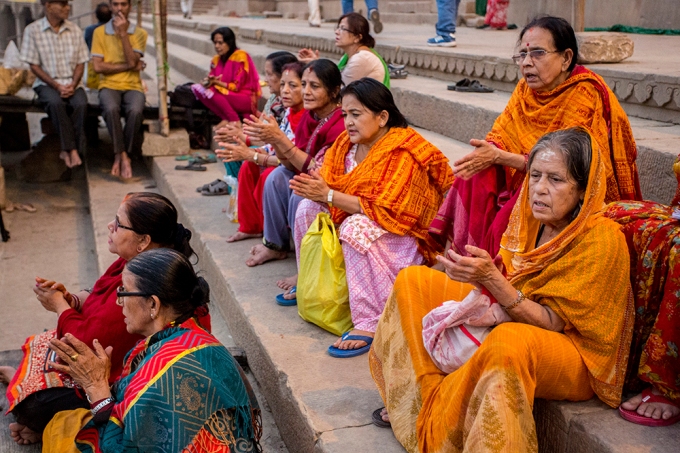
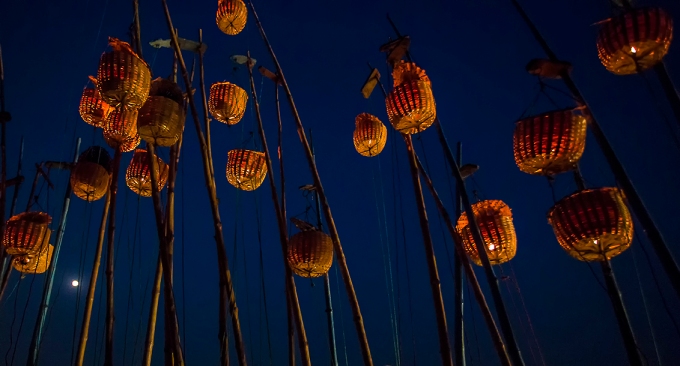
Long, lean bamboo poles with bamboo baskets dangling on the upper tips stood in clusters on Madhis (the platforms on both sides of the steps leading to Ganges.) on various ghats of Ganges at Varanasi. This is a common site on ghats in the Hindu month of Kartik. Every evening Diyas [earthen lamps] are lighted and placed in these baskets in the memories of ancestors, the symbolic significance being that these lamps light the path of the departed soul upto heaven. These are known as Aakash deep or Aakash kandeel. The tradition is said to run from as long as people can remember.
As twilight descends, the ripples on Ganges water hitherto bathed in golden sunlight, dancing merrily get sombre.Sky overhead dons it's inky blue night gown and Ganges flows placidly absorbing the calm greys of atmosphere. Groups of men and women with their pooja baskets start gathering near these bamboo poles.
This was the Kartik month of 2016 and we were on Nepali ghat at that evening. Preparations for lighting diyas were on. The hanging  baskets were lowered with the help of thin ropes attached to pulleys and baskets. Diyas taken out, filled with oil and fresh cotton wicks,  the lighted diyas placed inside basket and the basket once again pulled up on the poles.  The dangling baskets facing the sky and the flickering lights of Diyas paying homage to departed souls, women making rangolis near poles, chanting shlokas, praying with folded hands, lighting few more diyas on ground near each pole in the name of Gods and Goddess.... the entire scene filled the heart with peace and content. It was like a bridge of bonds and emotions has been erected from earth to heaven.The lighted baskets overhead moved slowly, rhythmically on the tune of winds. It felt as if the souls of ancestors are expressing their happiness, bestowing their blessings. What a beautiful concept of remembrance, gratitude and duty.
It is said that corresponding to the Diya in Aakash deep one more Diya is lighted on the ground near the respective pole. As if denoting that the lineage is alive and continuing. This one Diya is essentially lighted while rest are optional. one can light as many as one wants in the names of kul devtas, devis and other Gods.
 On one of the ghats these Aakash deeps were lighted in memory of martyrs, who lost their lives defending our country  during various terrorists attacks.
We also witnessed lighting of Aakash deeps at Ganga Mahal Ghat on the terrace of Krishna temple. on ghats the poles were erected on Madhis (рдордв़ी) near the steps of Ghats and the reflection of lighted Diyas could be seen in the Ganges water. View of Aakash deeps on terrace of temple from the ghats looked like a group of fireflies.
Aakashdeep are like lighted verse of prayers reaching zenith.
This month long event culminates on the day of Kartik Poornima.,when the glorious moon steps out in it's most magnificent form, smiling and assuring the lamps that the journey of light will go on for ever. 
deep_39nw

deep_59w

deep_60wdeep_57w

All pictures by Sunder Iyer.

Tuesday, June 28, 2016

Latu Devta

World of Hindu mythological tales and folklore is very interesting, charming and varied. It is believed that about thirty three crore Gods and Goddesses occupy Hindu pantheon. Quite possible…in a culture where many plants, animals and almost all the elements of nature are worshiped, where every small village, hamlet has it’s very own guardian angle, reaching even that staggeringly high  number is not out of bounds. With every revered place and deity are associated certain folklore and tales.The authenticity is neither questioned nor argued. It is simply accepted.
One of these is Latu devta of Wan. The folklore related to Latu Devta is very interesting and one of it’s own kind. Nanda devi is  one of the most revered deity of Uttaranchal. She is considered to be Avatara of Goddess Parvati and Latu Devta is her adopted brother. Goddess Parvati nee Nanda Devi did not have any brothers. On one occasion she felt very sad about this and wanted someone to be with her at Kailash Parvat as her brother. She went to Royal family of Kannauj and requested the queen to send one of her two sons with her to Kailash. On the way to Kailash they reached Wan and here Goddess decided to take bath in the river Kali Ganga. While waiting for Her on nearby hillock Latu felt very thirsty. He went to nearby hamlet and asked women to give him water. Women folk were in a jovial mood and instead of water handed over the pitcher containing local drink to Latu. Unaware of their prank Latu drank the whole content of pitcher and became unconscious. On her return from river, Goddess became very angry with the women and conferred a boon on Latu that he will be worshiped by the inhabitants of the area but no one will be allowed either to enter the sanctum of his temple or see him.Till date the doors of the temple are opened only for one day in a year and then too neither devotees nor even Pujari is allowed to have a glimpse of Devta. The Pujari enters the sanctum blind folded and lights the lamp. Doors of the temple is closed by evening.
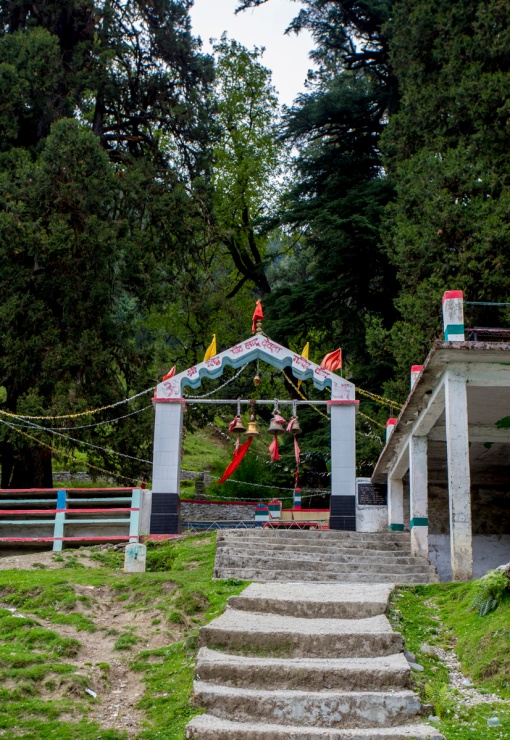
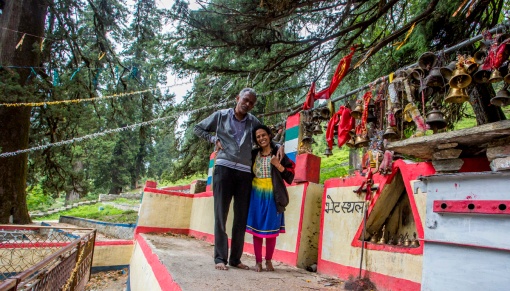
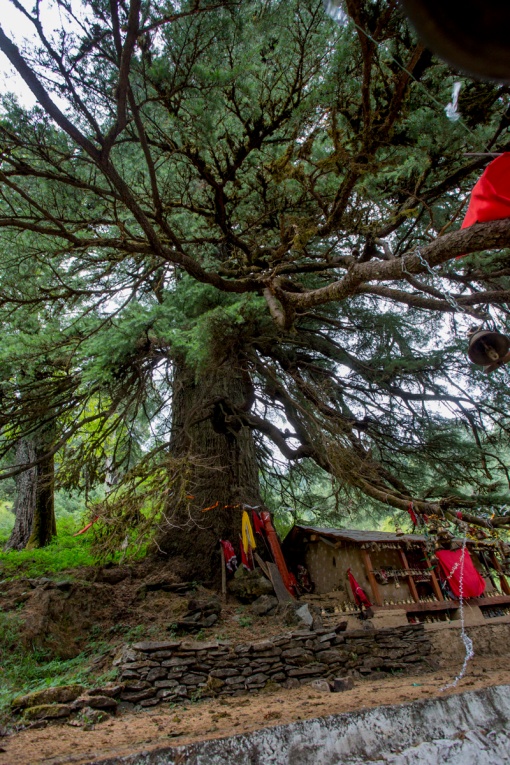
This temple is very different from any other temple. There is this massive Devdar tree at the place. It is the only Devdar found in entire region. Rest are centuries old Surai trees.There is another anecdote regarding presence of that single Devdar tree in the area. However I am not talking about that here as I am not able to recollect all the details narrated by the old gentleman, a retired porter, we met at Wan. So, the abode of Latu Devta is said to be inside the a chamber in the trunk of this Devdar tree.People of the area have great faith on Latu Devta. They visit the premises with their troubles and unburden their heart at His threshold and when the wish is fulfilled, the task done, they return to present a bell. Hundreds of bells hanging from poles are the testimony of people’s undying faith on the deity.The place becomes alive with massive crowd of devotees on the days of fair being organized there. People from far off villages come and stay in tents etc. Bhajans, Kirtans are sung in praise of Lord.
We first heard of Latu devta at Gwaldam.One local gentleman advised us that if we intend to go to Wan, we must go to Latu devta temple.During the day we spent at Wan village we heard His name many times from villagers and children.
While we were returning from Bedini, yashwant and Pushkar trekked upto Ran ka Dhar to meet us.In fact they knew we had to leave by evening and they wanted to spend as much time as possible with us.We too were delighted to have more of their company. With these two kids we went to Devta’s temple.Their enthusiastic company suffused enough strength into our tired limbs to trek upto the temple.
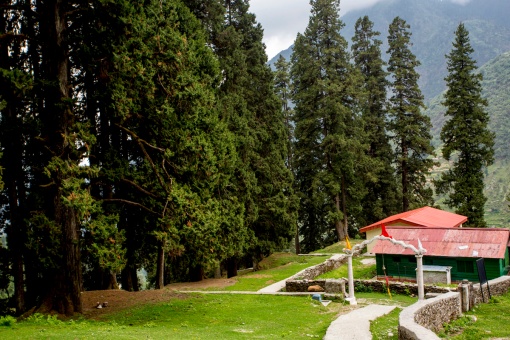
As we climbed towards temple we wished we had more time in hands.The Surai trees dotting the hill along the circuitous path leading to temple left us spellbound. Each one had it’s own tale to recount.They appeared so ancient as if they had witnessed all those mythological events unfolding. It is said that these trees have very long life. Don’t know much about their botanical characteristics but can definitely vouch for the enigmatic impact they imprint on your being. They look like wizened saint, lost in deep meditation.Their towering presence make you feel that they are the dwelling places of divine spirits. The secrets, the teachings, the lessons they have in their heart, one need to tune up to understand. Trees to me are one of the most sacred images of God.

bedni_13
Sonorous sounds of faith and devotion.
bedni_8

bedni_14
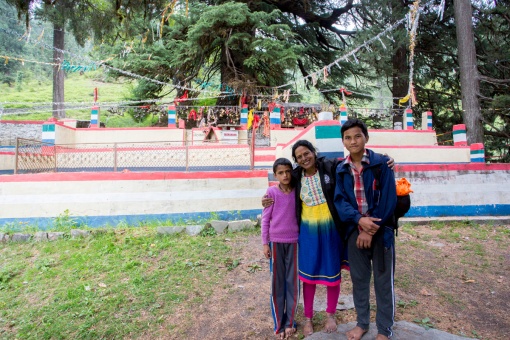
Behind us, under the tree is shrine of Latu Devta and these are the kids who brought us to temple. In fact before going to meet us at Ran ka Dhar they came here and kept incense sticks and match box…all set and ready …to be lighted by us when they brought us here. The little one Pushkar insisted that we should pray to Latu Devta for appeasement of our any wish. He had full faith that our wish will be fulfilled and then we would return to offer the bell. The faith, love and affection of kids filled my heart with sublime emotion. Kiddos, you are the harbingers of our hope and faith in all that is pure, innocent and selfless. We shall definitely love to return at least once.
bedni_3
This one was clicked by Yashwant, the elder kid, on their insistence ofcourse. That triangle like structure is where incense sticks are lighted by devotees.The outstretched arms of Devdar trees….bless us Lord.
bedni_12

bedni_15
There is a guest house of Garhwal mandal vikas nigam (tourism department) and another of forest department near the temple, on the hill. During Nanda Devi Jat Yatra, this is an important station for devotees.The time we were there the entire premises was very quiet, peaceful….kind of aura when you can feel nearer to God, more intimate to your best self.
bedni_5
View of Wan village and valley from temple.
bedni_16
Boys waiting for us to climb down from temple. They rush down speedily, said that going slow tire them.
bedni_2
‘A tree says: My strength is trust. I know nothing about my fathers, I know nothing about the thousand children that every year spring out of me. I live out the secret of my seed to the very end, and I care for nothing else. I trust that God is in me. I trust that my labor is holy. Out of this trust I live.’ Hermann Hesse
Pictures by Sunder Iyer

Wednesday, November 26, 2014

stacks of belief

As I sat there  amidst the stacks of prayer stones erected all over that particular hill at Talacauveri, I could feel the potent energy, the sanctity of the prayers said by various unknown people over the period of time. Those prayer mounds or the stacks of stones stood like folded hands raised in silent prayers towards the sky over head. Slowly moving rhythmic wind like a fairy with soft dainty steps halted besides the stacks and the stones whispered the prayers entrusted to them in her ever attentive ears. She in turn passed it on to fluffy clouds floating endlessly on the blue expanse of sky and clouds, the eternal carriers ensured that the prayers spread across the entire universe binding all of us in one thread of sacred brotherhood. What a blissful feeling it was, to be one with the moment and the entire world.


 I looked at those prayer stones and could imagine hands carefully choosing  and picking the stones that touched their soul, communicated to their hearts. Picking the stones for prayer stacks in itself  is an exercise of total mindfulness, of getting merged with the moment. Then placing stone upon stone with total concentration, balancing them one upon other with utmost care ensuring that the stack remained intact that in itself is akin to meditation. During the entire process one gets totally merged with the prayer and that complete surrender imparts the potent energy to the prayers .
One can also add pebbles to already existing stacks. when one carefully places a stone to an existing stack, our prayers and our thoughts merge with those of others who placed those stones earlier to us and thus the impact of prayers intensifies, each energizing other. What an enriching feeling this belief gives. Unknown we might be for one another yet we stand tied with that ethereal bond.


Rocks and stones have been used as an expression of our spiritual urge from times immemorial. Be it rock cut temples, images of Gods and Goddesses carved out of rocks or a stone kept under sacred trees and worshiped with all rituals, all these are manifestations of our sacred thoughts but these stacks of prayer stones are perhaps the earliest expressions of our spirituality.
Those mounds or stacks of prayer stones dotting the entire hill stood there under the open sky bearing the rains, the wind and other vagaries of weather. They as if represented firm beliefs withstanding all the tests of time and life.


All pics by Sunder Iyer.


Saturday, November 22, 2014

Talacauveri: The Verandah of Clouds...

Talacauveri is said to be the origin of mighty river Cauveri. It is around 48 Km from Madikeri. The source of the river does not look like as one would have imagined, a gurgling, foaming stream gushing down the hills . At the place there is this spring originating from Brahmagiri hills. An enclosure is built around it and same is connected to a small pond where pilgrims take the holy dip. The pond is surrounded by concrete steps and wide platforms from all sides.The spring runs underground from here and becomes visible after a few kilometers to flow as a river. Green hills from three sides stand there in silent reverence.
A view of the temple premises from hilltop


There is a shrine dedicated to Kaveriamma just in front of the pond. Ascending few more steps one reaches a wide open courtyard encircled by covered verandahs from three sides. In the courtyard are two temples, one of Lord Shiva, and another of Lord Ganesha. Lord Shiva here is known as Agastyeshwara. Ganesha, Muni Agastya and Cauveri.....that made me remember a mythological tale related to these three. If I remember correctly Agastya Muni brought waters from Shiva's abode Himalaya on Brahma's advice to make it flow as a river in Southern India to end the water woes of that part of our country. He was carrying  it in his kamandal and Ganesha in the form of a crow toppled the kamandal and the river Cauveri flowed. Or was it that in anger Agastya muni had arrested Cauveri river in his kamandal and then Ganesha in the form of crow toppled it to let the river flow.


The Temple premises


Talacauveri is a holy place for the people of Kodagu. It was told to us that on Tulasankranti day that is the first day of the tula masa, which usually falls on mid of october, water from spring gushes up at a predetermined moment. Thousands of pilgrims flock here on the day to witness the fountain head rising . This sudden spurt of water is known as Thirthodbhava and the belief is that Goddess Parvati emerges as Thirthodbhava. Pilgrims carry this holy water back to their homes. People observe the sacred tula snanam on the banks of Cauvery on this particular day. People of Kodagu believe that on this day Cauveri reaches every water body of the region be it well, pond or lake. Those who can't reach the banks of Cauveri carry water from the nearby water body to their home.
This place of origin of the river is about 1300 meter above the sea level. from here beautiful view of the distant blue hills and green valley can be enjoyed but the view from the hill top after ascending  near about 400 stairs is heavenly.


 The blue canvas


The place is very well maintained. As the steps leading to the hill top can be reached only after crossing the temple courtyard, we have to walk bare footed but who cares for that when one feels like floating in paradise.
While climbing the steps I stopped in between and glanced all around . With every few steps  the view became more ethereal. And once on the top...Ah.. I could have spent my entire life there standing and imbibing the beauty, the feel, the solitude.

The Verandah of clouds

In every direction distant misty blue hills stood holding hands, encircling the verdant valleys. Wrapped in dreamy haze the sublime hills whispered of a world beyond, a pure and divine world. Layers and layers of hills from misty blue to various hues of green stretched as far as eyes could see. Some appeared to be lulled in peaceful slumber under the balmy shadow of clouds floating overhead while others smiled serenely bathed in soft golden glow of sun light.


White fluffy clouds rolled all over the hills, pushing, nudging one another, somersaulting on velvety emerald expanse. Somewhere from womb of valley rose tall columns of clouds. The Master painter was at His work spilling pure white clouds on bright blue canvas overhead. Swiftly changing shapes of clouds created mesmerizing patterns.


The carpet of emerald velvet


Deep down in valley a tiny water body sparkled like a gem between grove of green trees. A solitary hut tucked midst greenery, a lone cart walking languorously on ribbon like road, hushed silence pervading the surrounding, filled my heart with a sense of gratitude.


This was a glorious moment, a moment to celebrate being a part of this magnificent world, a moment to be thankful for experiencing the pure joy and contentment of just being.


 Feeling Blessed


 In every walk with nature one recieves far more than he seeks.
-John Muir


 All pictures by Sunder Iyer


Wednesday, November 5, 2014

Raja's tomb--- Medikeri, Coorg

Raja's tomb--- does not that make one curious? It definitely intrigued me. A Hindu king and buried ? And that's not the only interesting fact, feature about this place of tourist attraction at Medikeri town of Coorg, Karnataka.
We visited Raja's tomb in October 2014. It was a balmy afternoon with clear blue sky and cool breeze, As I got down from the taxi in front of high gate of iron bars,  these kids trying to ride the elephants sculpted on platforms on either side of the gate made me smile. Their innocent laughter and mirth gave a perk to my holiday mood.


Inside the gate stood three structures in a straight line, distanced from one another by the green lawns in between. These structures are raised on square platforms, skirted by parapet. I was facing the back of the buildings. I started walking towards right side on the narrow, meandering gravel path running through the grassy patches. Bushes of various colored flowers in between the soothing green brightened the scene. After covering some distance I reached a small iron gate which was locked from inside. On the concrete square were two rectangular platforms . An idol of Nandi sat on each of these. On the side walls of platforms on black stone, I could see that something was engraved but from that distance it was not possible to read it. At that moment I could not know what these platforms denote. Why the statues of two Nandi were carved there? Rustling leaves  tried to whisper some tales of bygone era but alas that could not satisfy my curiosity rather ignited it a bit more.


moving forward on the circuitous path I reached the front of the tomb buildings.
Here in front of the middle tomb is a plaque that imparts certain information about the buildings, the tombs and other structures.
The central structure houses the tombs of Kondva king Dodaveerrajendra and his wife. Door of this structure was open when we visited. Inside was a Shivling and Nandi. Isn't it fascinating--- a temple within the tomb building.On the roof of the building is a dome in center flanked by minarets on the four corners. Well, these are the usual features of most of the sepulchral structures of Mughal time but what contributes to the uniqueness of these tombs are the Nandis sitting besides every minaret. what a fascinating amalgamation of two different cultures. The walls of tomb buildings are lined by windows and the side panels of these windows have carvings of various images of mythological and folk relevance and importance, each telling it's own tale. Every time I visit a historical monument with such images carved, I feel curious to know what it represent, what it depicts.


                                               A view of the back of Raja's tomb.


                                          An overview of a part of Medikeri town from a small hilly portio inside the campus.


                                                          Tomb of the royal priest.


                                           Inside view of Raja's tomb. The hanging lamp, the Shivalinga and other idols can be seen.


                                              Figures engraved on upper side of the window on the wall of tomb building. What or whom can these be representing? The figure on the left, the one with bow does that represent Rama or a Kodwa warrior and that on right---- is it some Rishi, praying but then why is he sitting on a boar. Is it representation of some folk tale or a mythological. So many thoughts race through minds. What you have to say about it?


                                           This one was interesting.....two bodies one face. Was the sculptor trying to engrave something symbolic...separate body, soul in unison or just because he had limited space on stone slab and that was the solution found for symmetry. Who can reach the nooks of a creative mind?


 This certainly is Ganesha and in the center ...is it depiction of Om.... and the figure in right ? Is it Ma Laxmi?


 These two figures stood on the gate of the central sepulchral structure. Dwarpals they could be representing . But the Trident  annd Damru in the hands of one figure suggests that it could be Shiva's representation. Quite logical too it appears as Lingayats are great worshipper of Shiva but do they subscribed to this avatara of Shiva or adhered to Linga form only. More over foot above snake ? We are used to snake on Shiva's neck. The symbols, signs and manifestations of the art and sculpture schools of that era had their own expressions, own language. We, as common tourist can interpret the same as per our own thoughts.


To the right of this tomb is the tomb of Lingarajendra built by his son Cheekaveerrajendra in A.D.1820. to the left is the tomb of royal priest Rudrappa built in  A.D. 1834. The two platforms with Nandis on them are tombs of two royal officials Biddanda bopu and his son Biddanda somaiah. Boddanda Bopu died fighting Tipu Sultan.

These kings of Paleri / Haleri dynasty ruled over Kodagu for about 200 years.[ 1580-1834]. From Haider Ali to Tipu Sultan these kings fought with the powers of Mysore to retain their individual and free identity. Kodwa people of Kodagu were brave, full of valor and were very loyal to their kings. After every defeat they rose with fresh strength .
Throughout the history of Coorg, no ruler has held direct sway over the region. Coorg has always been under the influence of local chieftains. The culture of Coorg has never been assimilated with the neighbors and has always maintained their unique identity.

Kodwa kings worshiped Shiva yet they were buried unlike all other followers of Hindu Dharma , whose body is burnt after death, this fact led me to search for an answer. Well, I came to know that these kings were Lingayats i.e. followers of Veershaiva faith.  Followers of this faith  wear a  symbol of Linga encased in a pendant around their necks. The faith preaches that Shiva is within every body and urges to worship the God within. Followers of this faith have their own unique customs, rites and traditions. During pregnancy of a woman on a certain month a  Guru gives the would be mother the pendant encasing Linga, tied to a thread ,which is to be worn by the child on the day of the birth itself and throughout his/her life that pendant with ishtlinga is on the body. May be the presence of Shivling and nandi inside king's tomb has something to do with this belief. Alive or dead God is with us, within us.


   All the pictures by Sunder Iyer

Sunday, May 22, 2011

SHANI SIGNAPUR___ABODE OF SHANI DEV


Shani Singnapur is a village located in Ahmednagar district of Maharashtra.It is about 70 km from shirdi and usually people visiting from faraway places combine both the divine places.
As the road turns from Shirdi for Shani Singnapur the scene changes dramatically.on both the sides of road are lush green fields of sugarcane and after almost every half kilometer or so is installed a sugacane crashing machine .Direct from the fields, under the shadow of big canopy of trees, midst the green ,savouring the juice is a delightful refreshing experience.
The presiding diety of Shani Singnapur is Shaneswar maharaj or Shanidev.He is personification of the planet saturn.There is no temple there and the black  stone swayambhu Shani dev stands there majestically under the vast blue expanse of sky.The spectcle is simply overpowering.
Only male devotees are permitted to climb the platform on which stands the idol of shani maharaj.Ladies can enter the premises but are not permitted to climb the platform. The devotees who want to pay offerings to god here have to first take a bath (in public bathrooms) and then pray wearing only lungis/vestis/mundus..................no upper cloth is permitted .
Big compound with many shops lined is there near the temple.Parking of vehicle is allowed inside this compound.Bathrooms are also located here only.lungis are available in the shops.rather provided with the offerings.Ofcourse you are supposed to return these.If you want you can purchase new ones which one can carry with him.
Any attempt to build a temple sheltering  the black stone pillar jutting out of the earth has not been successful.It is told that every time it was tried some or other catastrophy had fallen.There is a temple beside the platform of shani maharaj but it stands uncovered..mythologically it is believed that shanidev is son of God Sun and he wants always to be bathed by his (sun)blessings ..............hence he prefers to stand uncovered.
another unique feature of the village shani shingnapur is the houses without doors and windowpans.Even the shops have no shutters and doors.It is said that any attempt to put doors etc has always ended into some or other kind of misfortune for the person trying to do so.People believe that no theft or dacoity can ever occur in the place as miscreants have to bear wrath of Shani Dev.Its overwhelming to experience the power of faith .from the times unknown this belief is surviving.The place is truly ruled by Shani Maharaj.
Shani Shingnapur is one of the most revered shrine of Shani Bhagwan.It's proximity to Shirdi makes it easy to reach.It's worth visiting this otherwise incospicuous hamlet simply to witness and experience the charisma of faith.


a wandering hermit in the premises ...........


the majestic gate which leads to the long covered corridors leading to the shrine..........


the devotees after the bath .the nearby roads are full of devotees .the whole place as if painted in saffron..........


this is where a big basket is kept and all the offerings except the mustard oil has to be left here only.later on same can be collected.


photography near the shrine is prohibited......a glimpse of the platform from outside.devotees approaching for offering mustard oil to Shani Dev...........


another viewof the main gate .from the side gate we can have a glimpse of the platform in the open courtyard.


another group of devotees proceeding towards shrine with their guide............


in the hope of prasadam outside temple wall............


those little devotees were simply adoring.with musturd oil bottles in hands they walk towards shrine.........


shops selling the essentials.........no doors ,no shutters.even the rooms on first floor only curtains hang ........doors?no,not at all.


a close look at one of the shops.it's all red and orange here also............vibrantly coloured.........


the temple top from the market compound.this temple stands close to the shrine............


a house in the village.the plank is kept to keep the stray dogs away as the entrance does not have any door.


another home..........all these were at the side of road and this is the front view and main entrance of the home.


the little master was all set to proceed for school.he saw sunder focussing his camera on the door and there he was in front of his home striking a pose to oblige the cameraman..................


the hearth and the warmth..........home is where mother is............

all the pictures have copyright of sunder iyer.
© namitasachan., all rights reserved.