It was a cool January morning when we started from Jaipur to Bhangarh. The ride of about 52 Km. was full of beautiful pastoral scenes - small villages, green fields. Just before entering the limits of Bhangarh we passed through this village of idol, statues makers. the narrow muddy lane was lined by scores of statues of all sizes. Some were almost ready and stood tall in full glory while others lay scattered in semi finished states waiting for their turn to get shaped. There were Gods, Goddesses. dancers, angels, animals, flowers all carved out of white marble. outside every house of the village we could see these images.
On the way we stopped at two places to confirm the direction of Bhangarh. In front of a humble small house a middle aged man was working, we stopped the vehicle and enquired about the distance and direction. After guiding us suitably spontaneously he invited us to have some water, a gesture to welcome the guests. It really felt very good. The warm hearted traditions of our culture are still being followed/ preserved at least in some corners of our country. We had the same experience at other place too. Soul of soil still breaths.
Ruins of Bhangarh are known as the most haunted place of India or perhaps Asia too. Nobody is allowed to stay there after sunset. Prohibitory orders by archeological department to this effect are displayed on a board at the site. There are many versions of the story about Bhangarh ruins, the fate of the place. But today here I am not going to talk about the haunting quotient of the place as we didn't go there to explore that. We visited Bhangarh as a tourist place and the ruins communicated with me in a very different language.
After entering the first gate we walked on a neat, smooth cobbled path lined from both the sides by rows of roofless one rooms structures.It clearly gave an impression of being a market place.The walls were of boulders and in certain structures few stairs were seen, may be once they led to roof top or there was a first floor. Behind the rows of shops [ i will call them shops only] on one side at a distance spire of a temple could be seen amidst swaying green tops of trees. The area in between was strewn with piles of rocks, boulders while green stamped it's presence emphatically in all kinds of forms, from tiny grass blades to shady, thick canopy of huge trees. On other side behind the rows of shops various structures of ruins stood every where and behind these overlooking the entire scene was a continuous chain of hills, laden with greenery.
There were other groups of tourists too in the premises . Murmurs of voices could be heard in distance but overall, the serenity and quiet reigned.
At the end of the market there is another high , imposing gate. Crossing that the first structure we visited was Gopinath temple. The temple stands on a high platform. After ascending five-six steps we reached the open platform and sat there for some time imbibing the all around scenes. On one side of temple was open ground covered with green grass beyond which certain structures were visible and farther loomed the Aravali hills. Behind the temple at some distance stood the ruins of palace elegant in their deprivation closer to the heart of hills.As far as the eyes reached the roofless labyrinth of ruins as if whispered every thing on this earth comes with a definite span, everything comes to an end. But the message was conveyed in such a soothing serene way that it didn't make me afraid rather a sense of calm acceptance pervaded the being.
In the temple is a sanctum sanctorum and in front of sanctum is a circular space with ornately carved ceiling and beautifully paneled pillars. The inverted bowl shaped canopy and pillars have intricately carved images of dancers and musicians. This kind of music enclosures in front of sanctum was perhaps quite prevalent in ancient times. I have found so in many other old temples in different parts of our country. There is one in Lepakshi at Andhra Pradesh, one such circular one I saw in a temple at Pithoragarh. I am sure there are many examples of it places like Hampi etc. Singing, dancing, chanting have always been a part of our worshiping rituals. There is no idol inside sanctum. The only functional temple in the premises is Somesvara temple, the one devoted to Lord Shiva. Besides these two there are Hanuman temple. Kesav Rai temple and Mangla Devi temple .
On the extreme right of the palace there was this broken wall. I climbed on it and sat there for quite some time. Many feet down on the other side of the wall was dense growth of Kevra plants.A thin curved ribbon like kachcha path passed near it and then lost itself in the dense darkness of the forest ahead. Sitting there I could feel the green of earth touching the blue over head at a very very far point. A curtain of mist hung there as if trying to cover the sacred, the mystique from harsh, peering doubtful souls or may be signifying that what lies beyond, the sacred, the unknown is not perceivable through eyes. That was my moment of ultimate midst the ruins of Bhangarh. I did not feel fear of unknown, paranormal. I did not experience that overt enthusiasm of exploring, trekking. Rather I lived the serenity, breathed the calm.
History of Bhangarh --
It is said that Bhangarh was established somewhere in 1573 by Bhagwant Das. Bhagwant Das got it established as the residence of his younger son Madho Singh. Madho Singh was younger brother of famous Man Singh, general of emperor Akbar. After Madho Singh his son Chhatr Singh ruled over Bhangarh but after his death in 1630, Bhangarh started declining slowly. Later on Jai Singh II took control of Bhangarh . The famine of 1783 came as a final blow to gradually diminishing population of Bhangarh. It is said since then it lay uninhabited.
Folklores related to Bhangarh ---
Though historians attribute famine as reason of the abandonment and destruction of Bhangarh the folklore have their own tales to tell.
According to one legend Bhangarh perished due to curse of Guru Balunath. Guru Balunath was the person who permitted the establishment of Bhangarh at the place under one condition that shadow of the palace should never fall on his abode and the day it happened so, the town will be perished. To honour his words initially the palace of Bhangarh was erected upto three storeys.However later on when one of the rulers added a storey to the existing palace, it cast a shadow on Guru Balunath's residence and the town came to it's end as prophesied. It is said that Balunath lay buried in a small samadhi in Bhangarh.
There is another a more interesting legend related to Bhangarh, Ratnavati, the princess of Bhangarh was very beautiful. And there was a Tantrik named Singhia. He was master of many occult practices, He lived on a hill overlooking the palace, Once by chance he happened to have a glimpse of princess's face and fell in love with her immediately. He knew that she can never be his so he planned to bring princess under the influence of his occult practices. He used his black magic on the oil to be used by princess. Singhia was sure once the princess used that oil she would come running to him and surrender, It is said that the princess too had some knowledge of black magic and she could decipher Singhia's plan. She threw that oil on a big boulder which ran towards Singhia and crushed him to death but before breathing his last the Tantrik cursed that Bhangarh would perish soon. Soon after there was a war between Ajabgarh and Bhangarh in which the royal family, army and most of the population of Bhangarh was wiped off.
How to reach Bhangarh --
Bhangarh lies in Alwar district. nearest airport is of Jaipur and nearest railway station is Dausa. Distance of Jaipur is about 52 Km and Dausa is about 22 Km. Drive from Delhi is about of 300 Km. Route is Delhi, Gurgaon, Bhiwadi, Alwar, Thanagazhi, Ajabgarh ,Bhangarh. From Jaipur cabs can be hired . If you have only one day spare in hands then too can go to Bhangarh and even cover Abhaneri stepwell, one of the biggest and most beautiful stepwell. Sariska tiger reserve is about eighty Km from Bhangarh fort and the road is scenic and beautiful. However locals can guide you to many small yet beautiful places, temples in the vicinity.
 The way through the market. This must have been once the bustling, colourful place but then time always has it's own story to write.

 Temples in the premises.
 Front view of the remains of palace. Graceful in it's silence, wrapped in another time zone.

 Gopinath temple from outside. It has withstood the ravages of time.
 She is Munni, I met her while we were exiting the palace. She comes there with a bucket full of drinking water for tourists. Her small source of earning.
 Another view of Gopinath temple, Surreal, misty , calm inviting one to the world beyond
 My 'it' moment of intimacy with Bhangarh ruins..... soul to soul communication
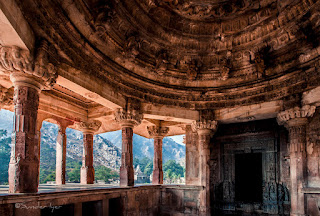 the ornate ceiling of Gopinath temple
 Somesvara temple
 Met him in the verandha of ruined palace. From that height today's world looked far away. He has many a tales of beliefs from his childhood to this age. ....kind of suspended moment.


Fixing my gaze on scattered ruins, the high arc of the gate, the temple, the palace , the crumbling fortification I was transported into the stage of deep meditation. Silence and solitude penetrated and spread within. Something of that ancient world came fleeting and nestled inside reassuringly.
All pictures by Sunder Iyer,
.
.
On the way we stopped at two places to confirm the direction of Bhangarh. In front of a humble small house a middle aged man was working, we stopped the vehicle and enquired about the distance and direction. After guiding us suitably spontaneously he invited us to have some water, a gesture to welcome the guests. It really felt very good. The warm hearted traditions of our culture are still being followed/ preserved at least in some corners of our country. We had the same experience at other place too. Soul of soil still breaths.
Ruins of Bhangarh are known as the most haunted place of India or perhaps Asia too. Nobody is allowed to stay there after sunset. Prohibitory orders by archeological department to this effect are displayed on a board at the site. There are many versions of the story about Bhangarh ruins, the fate of the place. But today here I am not going to talk about the haunting quotient of the place as we didn't go there to explore that. We visited Bhangarh as a tourist place and the ruins communicated with me in a very different language.
After entering the first gate we walked on a neat, smooth cobbled path lined from both the sides by rows of roofless one rooms structures.It clearly gave an impression of being a market place.The walls were of boulders and in certain structures few stairs were seen, may be once they led to roof top or there was a first floor. Behind the rows of shops [ i will call them shops only] on one side at a distance spire of a temple could be seen amidst swaying green tops of trees. The area in between was strewn with piles of rocks, boulders while green stamped it's presence emphatically in all kinds of forms, from tiny grass blades to shady, thick canopy of huge trees. On other side behind the rows of shops various structures of ruins stood every where and behind these overlooking the entire scene was a continuous chain of hills, laden with greenery.
There were other groups of tourists too in the premises . Murmurs of voices could be heard in distance but overall, the serenity and quiet reigned.
At the end of the market there is another high , imposing gate. Crossing that the first structure we visited was Gopinath temple. The temple stands on a high platform. After ascending five-six steps we reached the open platform and sat there for some time imbibing the all around scenes. On one side of temple was open ground covered with green grass beyond which certain structures were visible and farther loomed the Aravali hills. Behind the temple at some distance stood the ruins of palace elegant in their deprivation closer to the heart of hills.As far as the eyes reached the roofless labyrinth of ruins as if whispered every thing on this earth comes with a definite span, everything comes to an end. But the message was conveyed in such a soothing serene way that it didn't make me afraid rather a sense of calm acceptance pervaded the being.
In the temple is a sanctum sanctorum and in front of sanctum is a circular space with ornately carved ceiling and beautifully paneled pillars. The inverted bowl shaped canopy and pillars have intricately carved images of dancers and musicians. This kind of music enclosures in front of sanctum was perhaps quite prevalent in ancient times. I have found so in many other old temples in different parts of our country. There is one in Lepakshi at Andhra Pradesh, one such circular one I saw in a temple at Pithoragarh. I am sure there are many examples of it places like Hampi etc. Singing, dancing, chanting have always been a part of our worshiping rituals. There is no idol inside sanctum. The only functional temple in the premises is Somesvara temple, the one devoted to Lord Shiva. Besides these two there are Hanuman temple. Kesav Rai temple and Mangla Devi temple .
On the extreme right of the palace there was this broken wall. I climbed on it and sat there for quite some time. Many feet down on the other side of the wall was dense growth of Kevra plants.A thin curved ribbon like kachcha path passed near it and then lost itself in the dense darkness of the forest ahead. Sitting there I could feel the green of earth touching the blue over head at a very very far point. A curtain of mist hung there as if trying to cover the sacred, the mystique from harsh, peering doubtful souls or may be signifying that what lies beyond, the sacred, the unknown is not perceivable through eyes. That was my moment of ultimate midst the ruins of Bhangarh. I did not feel fear of unknown, paranormal. I did not experience that overt enthusiasm of exploring, trekking. Rather I lived the serenity, breathed the calm.
History of Bhangarh --
It is said that Bhangarh was established somewhere in 1573 by Bhagwant Das. Bhagwant Das got it established as the residence of his younger son Madho Singh. Madho Singh was younger brother of famous Man Singh, general of emperor Akbar. After Madho Singh his son Chhatr Singh ruled over Bhangarh but after his death in 1630, Bhangarh started declining slowly. Later on Jai Singh II took control of Bhangarh . The famine of 1783 came as a final blow to gradually diminishing population of Bhangarh. It is said since then it lay uninhabited.
Folklores related to Bhangarh ---
Though historians attribute famine as reason of the abandonment and destruction of Bhangarh the folklore have their own tales to tell.
According to one legend Bhangarh perished due to curse of Guru Balunath. Guru Balunath was the person who permitted the establishment of Bhangarh at the place under one condition that shadow of the palace should never fall on his abode and the day it happened so, the town will be perished. To honour his words initially the palace of Bhangarh was erected upto three storeys.However later on when one of the rulers added a storey to the existing palace, it cast a shadow on Guru Balunath's residence and the town came to it's end as prophesied. It is said that Balunath lay buried in a small samadhi in Bhangarh.
There is another a more interesting legend related to Bhangarh, Ratnavati, the princess of Bhangarh was very beautiful. And there was a Tantrik named Singhia. He was master of many occult practices, He lived on a hill overlooking the palace, Once by chance he happened to have a glimpse of princess's face and fell in love with her immediately. He knew that she can never be his so he planned to bring princess under the influence of his occult practices. He used his black magic on the oil to be used by princess. Singhia was sure once the princess used that oil she would come running to him and surrender, It is said that the princess too had some knowledge of black magic and she could decipher Singhia's plan. She threw that oil on a big boulder which ran towards Singhia and crushed him to death but before breathing his last the Tantrik cursed that Bhangarh would perish soon. Soon after there was a war between Ajabgarh and Bhangarh in which the royal family, army and most of the population of Bhangarh was wiped off.
How to reach Bhangarh --
Bhangarh lies in Alwar district. nearest airport is of Jaipur and nearest railway station is Dausa. Distance of Jaipur is about 52 Km and Dausa is about 22 Km. Drive from Delhi is about of 300 Km. Route is Delhi, Gurgaon, Bhiwadi, Alwar, Thanagazhi, Ajabgarh ,Bhangarh. From Jaipur cabs can be hired . If you have only one day spare in hands then too can go to Bhangarh and even cover Abhaneri stepwell, one of the biggest and most beautiful stepwell. Sariska tiger reserve is about eighty Km from Bhangarh fort and the road is scenic and beautiful. However locals can guide you to many small yet beautiful places, temples in the vicinity.


All pictures by Sunder Iyer,
.
.


.jpg)


