Friday, November 3, 2017

Hemakuta hills and the sunset, Hampi

It is said that Hemakuta hills have got a mythological connection to it's name. As per the story a local girl named Pampa [ after whose name the area is also known as Pampa kshetra and river Tungbhadra flowing through the region is  referred as Pampa  too] wanted to marry Lord Shiva. Impressed by her dedication and penance Shiva agreed to marry her. At the time of consenting to marry her Shiva was doing penance on this hill. At that moment it rained gold on this hill, hence the name Hemakuta, as Hema in Sanskrit means gold.
It was on this hill that Kamadev fell prey to Shiva's wrath for distracting Him from his penance. Kamsdev did so to help Pampa to marry Shiva but was burnt alive by Shiva's third eye. Later on on Rati's[ Kamadev's wife] request Shiva brought him back to life but not in physical form rather only in spirit.
Hemkuta hills is dotted with large number of shrines, mandapam , archways and pavilions. Some of these have been restored to large extent while others are ruins and yet others might have been obliterated completely. I think due to this Shiva connection perhaps almost all the temples on Humakuta hills are dedicated to Lord Shiva and two most important shrines of Ganesha.
Hemakuta hills is the most favourite sunset view point .It offers a great view and no steep climbing is required to reach the point. Hemakuta view point can be accessed through two sides - one from Virupaksha temple side and another from Sasivekalu Ganesha side. After a flight of few minutes the rocks stretch is almost plain.It is said that the temples on Hemakuta hills dates back to pre Vijayanagar empire period, about seventh century or so, though in certain temples great expansion and addition has been done during Vijaya nagar empire period.
The view point area itself is dotted with many structures, archways etc. The most recognized ones among them are Moola Virupaksha temple, which means original Virupaksha temple and small Hanumana shrine near the Frangipani tree on the top.
During our Hampi visit this oct. We enjoyed our first sunset at Hampi from Hemakuta hills.[ 24.10. 2017]
Sitting on the edge of that rock which plunged miles below in the vast valley strewn with boulders, dotted with greens of bushes and trees I was all set and ready to merge myself with the sunset sky. My gaze fixed on the stretch of the sky above the layers of hill range at the other end of valley, I absorbed the stillness of the moment. There were other groups of tourists scattered over the rocky terrain and murmur of voices could be felt but a kind of hushed expectant silence spread over the area. Every heart there was as if filled with deep reverence towards the most majestic, grand show of the day end. Sunset is there since humans are there on earth. So much has been said, written about it. We all must have witnessed more sunsets than we could count yet it’s charisma never fades. Every time we see the twilight slowly descending on earth, the lights gradually fading in oblivion, the majestic sun gliding on the sky, in and out of clouds and the blaze of colours…the golden yellows, the vibrant oranges, the silky blue turning into deep purple, the dashes of pink, our heart is filled with awe.
This sun there, must have seen the rise and fall of India’s one of the most prosperous empire. The setting sun must have kissed the Gopurams of the temples scattered all over Hampi with same equanimity whether they dazzled in their glory or lay buried in dust and mud. The thought gave me a feeling of timelessness. The whispering leaves of the lone tree near the small shrine on rocks fell into a silence. Wind too sang in hushed notes. All around us a sweet tranquility prevailed. Occasionally the sound of bells from Virupaksha temple groups reached us. It was a wonderful moment. A reassuring one when, suddenly that trust, that belief takes deep root within you that….everything is alright, everything happens for good.
After the curtain fell over the majestic show of the sunset, I lay there on the rock watching the tiny pale stars slowly walking in….life felt just so perfect.


 Reaching out to departing sun…. May all your yearnings be satisfied. On the extreme right is Moola Virupaksha temple.

 sipping the light….drop by drop I inhale and glow…..Hanuman temple


 The distant echoes of sunset sky are silently absorbed by the puddle . During the long, dark night every colour comes alive to whisper soothing lullabies to still waters.
 Before the curtain is finally pulled…. tender caresses of wind makes me feel light and feathery, the silky blue spreads in eyes and pearly pink nestles inside….. I am ready to surrender.


 Slowly Sun wraps up it’s golden orange extravaganza and starts fading into oblivion leaving stage to softer, subtler colours….. yes, the stage has to be shared to make the display more beautiful deep and complete.. Every one deserves a chance and each has it’s special attributes.


All pictures by Sunder Iyer.

Wednesday, October 11, 2017

harshat mata temple


 We were  nearing Abhaneri to visit the famous step well Chand Bowari, when midst wide spread green fields this brownish ancient structure looking striking against the sparkling blue sky caught our attention. In fact before stepping in to the premises we were totally unaware of the existence of Harshat Mata temple. Yes, very poor research work before setting off for an excursion but this lack on our part increased our joy of encounter with this temple manifold. It was like stumbling upon a treasure trove and a treasure trove of the finest quality of sculpture and carving it is.
If we take into account the broken panels kept in the temple premises, the idols kept in the verandah encircling Chand Bowri and innumerable sculptures from this temple donated to various museums in our country, we could imagine what a grand, magnificent and huge temple complex it would have been in it's days of glory.
Harshat Mata temple has faced massive destructive and damaging attacks yet faith survived. The sanctum is there, deity is there. Pooja archna is done on daily basis what suffered is  a jewel of architecture marvel par excellence.Still on pillars, the panels, the ceiling of domes can one find many mythological themes, Gods, Goddesses and scenes from royal life carved intricately. Each image, each panel deserves a detailed description. One needs time to appreciate each piece.
 There is Shiva in His various forms-- Ardhnarishwara, Natraja or dancing Shiva etc. Goddess, Shakti in the forms of  Mahishasurmardini, Gajalaxmi, Parvati, chamundi, Saptmatrika etc, Laxminarayana, Vishnu. Ganapati. Kartikeya, Sun God and many other deities with mixed features of different Gods and then are dancers, ballerinas, garden scenes, court scenes. various kinds of ornaments with minute details in vogue that period, dresses. weapons...myriad glimpses of social fabric. Harshat mata temple literally is a kind of  an open mythological and cultural encyclopedia in stone, if you know how to fathom the depths.


All Pics by Sunder Iyer


.

Sunday, September 24, 2017

Chand Bawori

Stepwells in India came into existence long long back. They were born out of necessity, simple water reservoir kind of structure. They were dug deep into earth and steps were created so that villagers could reach  the lowest level during dry hot months when water level recedes considerably...
during monsoon torrential rains filled these wells and that guaranteed the year long uninterrupted supply of water.
These stone cistern looking down deep into heart of earth were marvels of architecture even in their most simplest forms and some of those which evolved in their structures are astounding to look at.
One such step well is Chand Baoli in Abhaneri in Rajasthan.
We started from jaipur very early in the morning and after spending few hours at Bhangarh we covered Abhaneri too the same day. Though before visiting Chand baori I had read about it and seen pictures too but nothing prepared me for the astounding magnificence of the structure. Symmetrical steps running down in an identical pattern on the three side walls of massive reservoir created an impact of rhythmical, harmonious ode... an ode it is..ode to the skill, craftsmanship and imagination of those artist/ sculptors of bygone era.
The terraced steps walk down to almost thirteen levels and each level is said to be of about five feet. The number of steps carved is said to be approximately 3500. At the end water lay studded like  a precious stone in the frame of the ring. On the fourth side are built three pillared enclosures, on the pillars facing water are sacred images of Goddess Durga and Lord Ganesha.

It is said that the place was earlier known as Abhanagari which later on was distorted into Abhaneri. Chand Bawari was built in 8th to 9th century by Chand Raja, the then ruler of the area. The Bawari is named after him only. It is said that long back there were two rivers in the area Bana river and Sang river. This bawari was built between these two rivers in such a way that during rainy season when the level of water in the rivers used to rise, the water flowed into the Bawari. I think that served two purposes ... if at all the torrential rains threatened to submerge the area in floods, that danger was completely obliterated and second one of course the obvious one, the water was stored in the well to be used during summers when there was scarcity of water. Today also it is said that level of water during monsoon rises about three levels from below.
We were also told that originally on the fourth side was a ramp going down. This was built for taking down the animals to drink water. Later on that small summer palace was built by Raja Man Singh first. There are rooms in which royal family used to rest seeking refuge from the scorching heat of summers. Not only for royal family the steps of the well also served as sanctuary for travellers and common public providing them cool respite from hot sun above. This place also served as an arena for public meetings conducted by royal family. villagers used to sit on the steps on three sides while king, queen and other dignitaries of importance sat on the chhataris built on fourth side. What a multi utilitarian structure ! and to this day the astounding master piece stand there quenching our thirst for aesthetic and beauty.
Chand Baori, it's premises, the lawns surrounding it - all are very well maintained, neat, clean, sparkling.
In the premises around the bawari runs covered verandahs on three sides. These verandahs serve as a kind of open museum of a number of finest sculpted, carved idols. It is said that these sculptures were part of the adjacent Harshat mata temple. The temple was plundered and destroyed/damaged by Mahmud Gazhani . Later on these sculptures scattered all over the area were collected and kept here. The temple still is there. But I shall talk about the temple and beautiful sculptures in my another post.
outside Chand bowri there is a small market where besides few eateries one can also find few shops of local handicrafts.


Locals there told us that on way back to Jaipur from Abhaneri if we have time we can also visit Bhandarej ki Bawari. From Dausa this bawari is about three km. away. We didn't go there due to paucity of time in hand but thought of mentioning it, if some other enthusiast is interested in exploring.


closer to the heart of earth runs the nectar of life                           


                       Asymmetry might be compelling but then symmetry is so comforting.


All pictures by Sunder Iyer.

.

Tuesday, September 12, 2017

Bhangarh

It was a cool January morning when we started from Jaipur to Bhangarh.  The ride of about 52 Km. was full of beautiful pastoral scenes - small villages, green fields. Just before entering the limits of Bhangarh we passed through this village of idol, statues makers. the narrow muddy lane was lined by scores of statues of all sizes. Some were almost ready and stood tall in full glory while others lay scattered in semi finished states waiting for their turn to get shaped. There were Gods, Goddesses. dancers, angels, animals, flowers all carved out of white marble. outside every house of the village we could see these images.
On the way we stopped at two places to confirm the direction of Bhangarh. In front of a humble small house a middle aged man was working, we stopped the vehicle and enquired about the distance and direction. After guiding us suitably spontaneously he invited us to have some water, a gesture to welcome the guests. It really felt very good. The warm hearted traditions of our culture are still being followed/ preserved at least in some corners of our country. We had the same experience at other place too. Soul of soil still breaths.

Ruins of Bhangarh are known as the most haunted place of India or perhaps Asia too. Nobody is allowed to stay there after sunset. Prohibitory orders  by archeological department to this effect are displayed on a board at the site. There are many versions of the story about Bhangarh ruins, the fate of the place. But today here I am not going to talk about the haunting quotient of the place as we didn't go there to explore that. We visited Bhangarh as a tourist place and the ruins communicated with me in a very different language.

After entering the first gate we walked on a neat, smooth cobbled path lined from both the sides by  rows of roofless one rooms structures.It clearly gave an impression of being a market place.The walls were of boulders and in certain structures few stairs were seen, may be once they led to roof top or there was a first floor. Behind the rows of shops [ i will call them shops only] on one side at a distance spire of a temple could be seen amidst swaying green tops of trees. The area in between was strewn with piles of rocks, boulders while green stamped it's presence emphatically in all kinds of forms, from tiny grass blades to shady, thick canopy of huge trees. On other side behind the rows of shops various structures of ruins stood every where and behind these overlooking the entire scene was a continuous chain of hills, laden with greenery.
There were other groups of tourists too in the premises . Murmurs of voices could be heard in distance but overall, the serenity and quiet reigned.
At the end of the market there is another high , imposing gate. Crossing that  the first structure we visited was Gopinath temple. The temple stands on a high platform. After ascending five-six steps we reached the open platform and sat there for some time imbibing the all around scenes. On one side of temple was open ground covered with green grass beyond which certain structures were visible and farther loomed the Aravali hills. Behind the temple at some distance  stood the ruins of palace elegant in their deprivation closer to the heart of hills.As far as the eyes reached the roofless labyrinth of ruins as if whispered every thing on this earth comes with a definite span, everything comes to an end. But the message was conveyed in such a soothing serene way that it didn't make me afraid rather a sense of calm acceptance pervaded the being.
In the temple is a sanctum sanctorum and in front of sanctum is a circular space with ornately carved ceiling and beautifully paneled pillars. The inverted bowl shaped canopy and pillars have intricately carved images of dancers and musicians. This kind of music enclosures in front of sanctum was perhaps quite prevalent in ancient times. I have found so in many other old temples in different parts of our country. There is one in Lepakshi at Andhra Pradesh, one such circular one I saw in a temple at Pithoragarh. I am sure there are many examples of it places like Hampi etc. Singing, dancing, chanting have always been a part of our worshiping rituals. There is no idol inside sanctum. The only functional temple in the premises is Somesvara temple, the one devoted to Lord Shiva. Besides these two there are Hanuman temple. Kesav Rai temple and Mangla Devi temple .
On the extreme right of the palace there was this broken wall. I climbed on it and sat there for quite some time. Many feet down on the other side of the wall was dense growth of Kevra plants.A thin curved ribbon like  kachcha path passed near it and then lost itself in the dense darkness of the forest ahead. Sitting there I could feel the green of earth touching the blue over head at a very very far point. A curtain of mist hung there as if trying to cover the sacred, the mystique from harsh, peering doubtful souls or may be signifying that what lies beyond, the sacred, the unknown is not perceivable through eyes. That was my moment of ultimate midst the ruins of Bhangarh. I did not feel fear of unknown, paranormal. I did not experience that overt enthusiasm of exploring, trekking. Rather I lived the serenity, breathed the calm.


History of Bhangarh --
It is said that Bhangarh was established somewhere in 1573 by Bhagwant Das. Bhagwant Das got it established as the residence of his younger son Madho Singh. Madho Singh was younger brother of famous Man Singh, general  of emperor Akbar.  After Madho Singh his son Chhatr Singh ruled over Bhangarh but after his death in 1630, Bhangarh started declining slowly. Later on Jai Singh II took control of Bhangarh . The famine of 1783 came as a final blow to gradually diminishing population of Bhangarh. It is said since then it lay uninhabited.


Folklores related to Bhangarh ---

Though historians attribute  famine as reason of the abandonment and destruction of Bhangarh the folklore have their own tales to tell.

According to one legend Bhangarh perished due to curse of Guru Balunath. Guru Balunath was the person who permitted the establishment of Bhangarh at the place under one condition that shadow of the palace should never fall on his abode and the day it happened so, the town will be perished. To honour his words initially the palace of Bhangarh was erected upto three storeys.However later on when one of the rulers added a storey to the existing palace, it cast a shadow on Guru Balunath's residence and the town came to it's end as prophesied. It is said that Balunath lay buried in a small samadhi in Bhangarh.


There is another a more interesting legend related to Bhangarh, Ratnavati, the princess of Bhangarh was very beautiful. And there was a Tantrik named Singhia. He was master of many occult practices, He lived on a hill overlooking the palace, Once by chance he happened to have a glimpse of princess's face and fell in love with her immediately. He knew that she can never be his so he planned to bring princess under the influence of his occult practices. He used his black magic on the oil to be used by princess. Singhia was sure once the princess used that oil she would come running to him and surrender, It  is said that the princess too had some knowledge of black magic and she could decipher Singhia's plan. She threw that oil on a big boulder which ran towards Singhia and crushed him to death but before breathing his last the Tantrik cursed that Bhangarh would perish soon. Soon after there was a war between Ajabgarh and Bhangarh in which the royal family, army and most of the population of Bhangarh was wiped off.


How to reach Bhangarh --
Bhangarh lies in Alwar district. nearest airport is of Jaipur and nearest railway station is Dausa.  Distance of Jaipur is about 52 Km and Dausa is about 22 Km. Drive from Delhi is about  of 300 Km. Route is Delhi, Gurgaon, Bhiwadi, Alwar, Thanagazhi, Ajabgarh ,Bhangarh. From Jaipur cabs can be hired . If you have only one day spare in hands then too can go to Bhangarh and even cover Abhaneri stepwell, one of the biggest and most beautiful stepwell. Sariska tiger reserve is about eighty Km from Bhangarh fort and the road is scenic and beautiful. However locals can guide you to many small yet beautiful places, temples in the vicinity.


The way through the market. This must have been once the bustling, colourful place but then time always has it's own story to write.

                                                               Temples in the premises.
Front view of the remains of palace. Graceful in it's silence, wrapped in another time zone.

Gopinath temple from outside. It has withstood the ravages of time.
She is Munni, I met her while we were exiting the palace. She comes there with a bucket full of drinking water for tourists. Her small source of earning.
Another view of Gopinath temple, Surreal, misty , calm inviting one to the world beyond
My 'it' moment of intimacy with Bhangarh ruins..... soul to soul communication
                                                      the ornate ceiling of Gopinath temple
                                                                   Somesvara temple
Met him in the verandha of ruined palace. From that height today's world looked far away. He has many a tales of beliefs from his childhood to this age. ....kind of suspended moment.


Fixing my gaze on scattered ruins, the high arc of the gate, the temple, the palace , the crumbling fortification I was transported into the stage of deep meditation. Silence and solitude penetrated and spread within. Something of that ancient world came fleeting and nestled inside reassuringly.


All pictures by Sunder Iyer,

.

.

Sunday, June 4, 2017

Pademchen to nathang

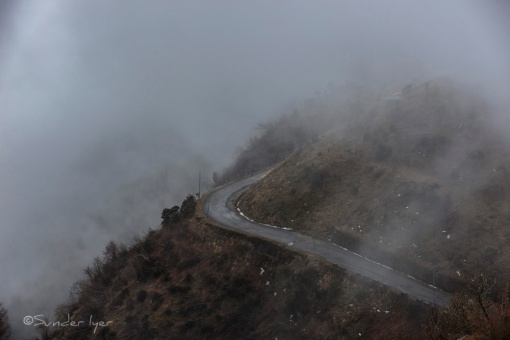
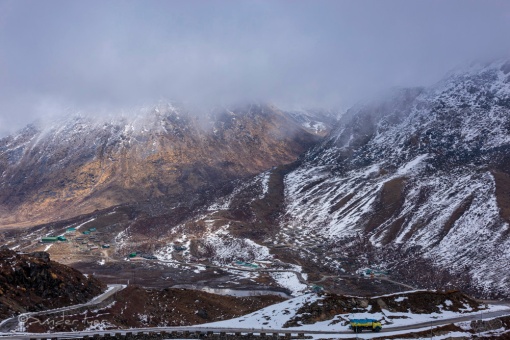
As we started climbing upwards from Padamchen to Nathang scenery around us started changing. The greens receded back and brown, grey dominated the screen . It was not a bright day. Sky too was laden with grey clouds. However as we moved forward patches, heaps of white crystallized snow could be seen on the sides of road. May be it was a day old or so. The sparkling sheen had diminished a bit yet it added a delicacy to otherwise brown sternness of high, mighty mountains. somewhere snow clung to the wide powerful chests of mountains as if feeling secured in their solidity.


joka_3


 joka_21
Further up and we were engulfed in whiteness. Except the road we were traveling on,it was white everywhere and snow there was soft like cotton balls,,,,fresh cool, soft snow.In the background at a distance mountains created a chain of rising falling waves on grey waters. At some places solid sheet of pewter sky watched over us unblinking while on other occasions white , grey clouds floated in like rosette and on still another moment the sailing clouds formed a translucent curtain pushing everything under it's fold, creating a mystical world ,tempting us to plunge head-along in their depths to soar in that world beyond.

joka_16(1)


joka_23n


 joka_25


Mountains don their snow robes with an unmatched sublimity. The grace with which they let snow clad them in different patterns add to their majestic grandeur and how they appear to smile with indulgence.


joka_27


joka_28


 joka_29


On the way intermittently military establishments and few hutments lay under the shadow of the mountains where snow does not melt even in summers. From a distance candy coloured green, yellow, rust , sloping roofs of barracks and huts added a bit of brightness. How hard is life up there for the people due to whom we can nestle in the warmth of our homes and hearths. We can never show enough gratitude to these brave hearts.

 joka_30


 joka_63n


And then there were lakes --- It is said that Sikkim has about 225 lakes and innumerable water falls. We on our trip came across three main lakes.
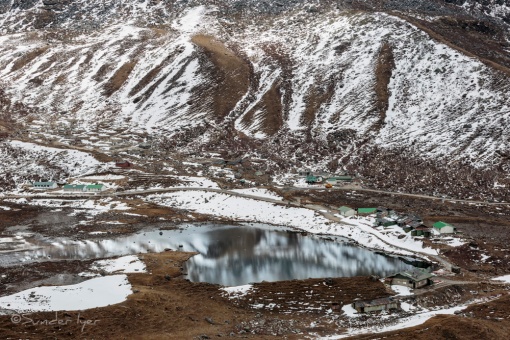
Manju lake ... At the height of 136oo ft.  Manju lake lay nestled amidst high snow clad mountains. Nathula pass is about seven Km. from this lake. The serenity, the calm was overwhelming.


 joka_50

 Kuppup lake or elephant lake ... every tourist on old silk route visit this lake. We were on the spot in the first week of April. The lake was partially frozen and partially melted. We walked upto nearby ridge to have a complete view of lake, valley and snow laden mountains beyond the lake. On the other side of the road too white fluffy carpet of snow stretched over the hills, mountains . Cold gusty wind was blowing. Grey clouds rushed off and on displaying their antics. At a moment clouds went down embracing the lake and at another lifting their frilly gown they rushed back to the other side of mountain ranges.At yet another the clouds cautiously peeped down from the peaks watching their reflections in the crystal clear waters of the lake and then unable to restrain themselves they ran down hand in hand with the winds to bless us with their feathery nearness. It was chilling, it was freezing yet such mesmerizing was the beauty unfolded before us that we stood there rooted on the spot. Kuppup lake is called elephant lake as when frozen completely it resembles an elephant in shape, however we were able to trace down the trunk.

joka_36


joka_12nnw


 joka_33

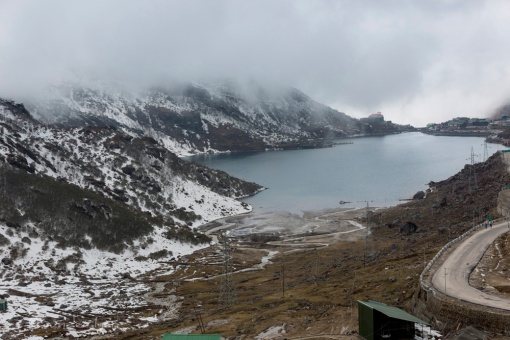
From Kuppup lake we proceeded to Changu lake. Changu lake is also known as Tshangu Lake. This lake and it's surrounding landscape The lake at an altitude of about 12400 ft. lay nestled in the arms of high snow clad mountains.This is one of the highly revered lake of Sikkim.  It is a sacred lake both for Buddhists and Hindus.
This was the tourist season so the lake has many visitors, every group enjoying as per their own taste and interest.There is a temple at the bank of lake and beyond that high snow covered mountains. In this season trekking on the mountains can be enjoyed. Gum boots, canes and all other accessories facilitating the trek could be hired in the nearby small, local market.Rows of decorated yaks stood there with their masters to give a ride to visitors.
But despite all the tourist humbug if you want to be alone with the lake, you can easily do that. Walk a few feet away and the blue waters start whispering the mystical chants flowing down from the lands of the high peaks of mountains. Somewhere up there, beyond our reach, lies a world  cradled and caressed by fluffy floating clouds. And I want it to be there only, far away from us, beckoning and reassuring. They say that the lake gets completely frozen in winters and then perhaps angels float down on glassy white surface of the lake to dance and enjoy under a clear star lit sky.


joka_42
A quiet time with Changu lake


joka_45
yak riding, trekking on other side of the lake


joka_46
The temple


joka_47


joka_48


joka_49
Waiting for their turn


joka_64n.jpg


joka_14


joka_11


The snow, the mountains, the peaks, the valleys, the streams, the lakes, the winding paths, the sky, the clouds. mesmerizing, panoramic scenes all stirred kaleidoscopic emotions but my heart overflowed with feelings of gratitude and reverence for these quiet, dignified, brave sentinels, They represent the real spirit of mountains.

All the pics by — Sunder Iyer.